Annapurna Bhandar Scheme 2026: Apply Online, Eligibility, Status Check & Latest Update
What Is Annapurna Bhandar?
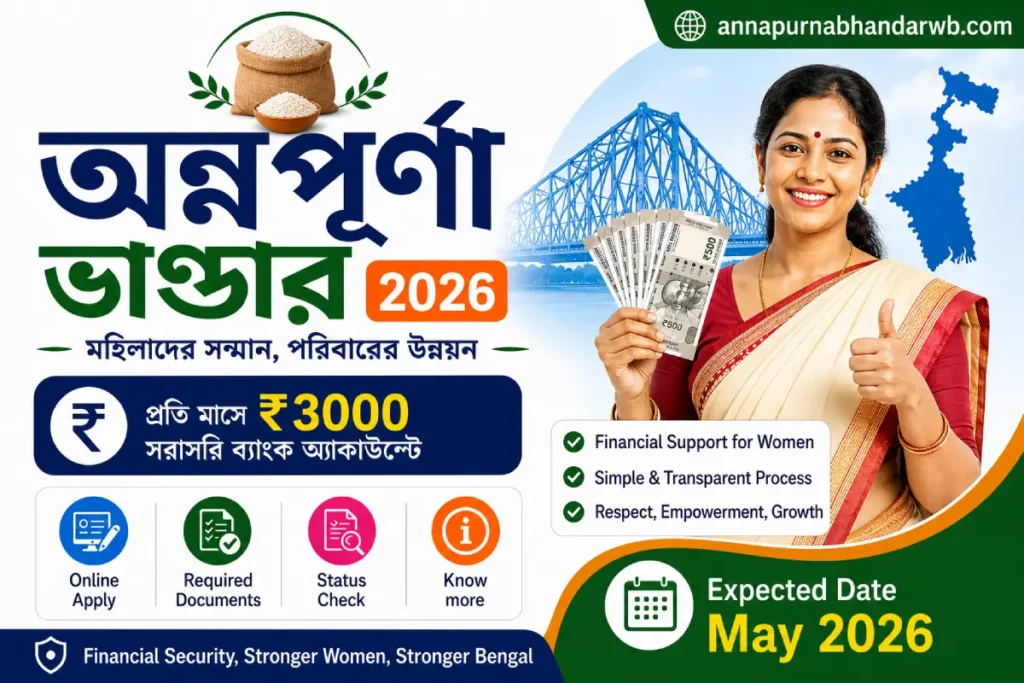
The Annapurna Bhandar Scheme (also referred to as Annapurna Yojana or Matri Shakti Bharosa Scheme) is the newest major women’s welfare programme of the Government of West Bengal. Announced on 11 May 2026 during the first cabinet meeting of the newly formed BJP government under Chief Minister Suvendu Adhikari, this scheme will officially roll out from 1 June 2026.
The scheme replaces the previous Trinamool Congress government’s flagship Lakshmir Bhandar Scheme — expanding the monthly cash transfer from ₹1500–₹1,700 to a uniform ₹3,000 per month for eligible women across the state. It is, by any measure, one of the largest direct benefit transfers to women in West Bengal’s history.
Key Highlights at a Glance
| Detail | Information |
|---|---|
| Scheme Name | Annapurna Bhandar / Annapurna Yojana |
| Also Known As | Matri Shakti Bharosa Scheme |
| Launched By | BJP Government, West Bengal |
| Chief Minister | Suvendu Adhikari |
| Announced On | 11 May 2026 (First Cabinet Meeting) |
| Official Launch Date | 1 June 2026 |
| Monthly Benefit | ₹3,000 per month |
| Mode of Transfer | Direct Benefit Transfer (DBT) |
| Target Beneficiaries | Women heads of household (25–60 years) |
| Estimated Coverage | 2.21+ crore women |
| Administered By | Dept. of Women & Child Development and Social Welfare, WB |
| Official Notification | No. 2411-WCD/O/AB-4/2026 dated 19 May 2026 |
The Story Behind the Name
The name “Annapurna” is deeply symbolic. In Hindu tradition, Goddess Annapurna is the deity of food, nourishment, and abundance — the keeper of the kitchen and the guardian of the household. Naming this scheme Annapurna Bhandar (“Treasury of Annapurna”) carries both cultural resonance and a political message: this government, too, will feed and sustain Bengal’s families — through cash, not grain.
The BJP had promised this scheme during the 2026 West Bengal Assembly Election campaign as a direct counter to Lakshmir Bhandar, doubling the benefit amount and broadening the scope. Upon winning the election, one of their first acts was fulfilling this promise.
Who Is Eligible?
You ARE eligible if:
- You are a woman (only women are eligible under this scheme)
- You are a permanent resident of West Bengal
- Your age is between 25 and 60 years
- You have an Aadhaar-linked bank account for DBT receipt
- You are from a family that does not have a member who is an income taxpayer
You are NOT eligible if:
- You are an income taxpayer
- You are a permanent or retired government employee (state or central)
- You receive a regular salary or pension from the state/central government, panchayats, statutory bodies, local bodies, municipalities, or government-aided educational institutions
Documents Required
While the government has not yet released the complete final document list, based on the official portal guidance, the following are expected to be required:
- Aadhaar Card (mandatory — for Aadhaar-linked DBT)
- Voter ID / Election Commission Photo ID
- Bank Passbook (Aadhaar-linked account)
- Age Proof (Birth certificate, Madhyamik admit card, etc.)
- Residence Proof (Ration card, utility bill, etc.)
- Income Certificate (to establish non-taxpayer status)
- Caste Certificate (if applicable — for SC/ST verification)
Note: Existing Lakshmir Bhandar beneficiaries may not need to submit fresh documents. Automatic migration is planned for all valid, verified existing beneficiaries.
What Happens to Existing Lakshmir Bhandar Beneficiaries?
This is the most important question for the 1.7 crore women already receiving Lakshmir Bhandar benefits, and the government has been clear:
- Automatic migration: All existing Lakshmir Bhandar beneficiaries will be automatically moved to Annapurna Bhandar after verification — no fresh application needed.
- Exceptions to migration: Beneficiaries identified as deceased, shifted out of state, deleted from electoral rolls, or found ineligible during re-verification will NOT be migrated.
- Special protection: Beneficiaries who have filed appeals before the SIR Tribunal or submitted applications under the Citizenship (Amendment) Act will continue receiving benefits until their cases are disposed of.
- Portal update: The old Lakshmir Bhandar portal has been officially renamed to the Annapurna Bhandar portal as of 18 May 2026.
How to Apply (From 1 June 2026)
For new applicants who were not previously on Lakshmir Bhandar, online registration will open on 1 June 2026 through the official portal.
Step-by-Step Application Process:
- Step 1: Visit the official Annapurna Bhandar Scheme portal (the updated former Lakshmir Bhandar portal).
- Step 2: Click on “New Application” or “Apply Online.”
- Step 3: Enter your registered mobile number and verify via OTP.
- Step 4: Fill in your personal details — name, age, address, family details, and Aadhaar number.
- Step 5: Enter your Aadhaar-linked bank account number for DBT credit.
- Step 6: Upload required documents (Aadhaar, voter ID, bank passbook, income certificate, etc.).
- Step 7: Submit the application and save your acknowledgement number for future status tracking.
Tip: Keep your Aadhaar card and bank passbook handy before beginning the application. Ensure your bank account is Aadhaar-seeded — without this, the DBT transfer cannot be processed.
The Financial Picture: What ₹3,000 Means
At ₹3,000 per month per beneficiary, and with a projected 2.21 crore women covered, the annual outlay for Annapurna Bhandar is estimated at roughly ₹79,000–₹85,000 crore per year — a significant jump from the approximately ₹42,000 crore earmarked for Lakshmir Bhandar under the previous government.
For comparison:
- Lakshmir Bhandar (TMC): ₹1500–₹1,700/month
- Annapurna Bhandar (BJP): ₹3,000/month →
This is a massive fiscal commitment. Economists have already raised concerns about the sustainability of such transfers alongside the state’s existing debt burden and the falling share of infrastructure spending (which had dropped to around 3% of GDP in recent years). The government has not yet publicly detailed how this will be financed.
Annapurna Bhandar vs. Lakshmir Bhandar: What Changed?
| Feature | Lakshmir Bhandar (TMC) | Annapurna Bhandar (BJP) |
|---|---|---|
| Monthly amount | ₹1500 (General), ₹1,700 (SC/ST) | ₹3,000 (uniform) |
| Age eligibility | 25–60 years | 25–60 years |
| Transfer mode | DBT | DBT |
| Portal | Lakshmir Bhandar portal | Annapurna Bhandar portal (same, renamed) |
| Caste differentiation | Yes | No (uniform ₹3,000) |
| Coverage | ~1.7 crore | ~2.21 crore (projected) |
| Free bus travel | Not included | Included (parallel announcement) |
Additional Benefit: Free Travel for Women
Alongside Annapurna Bhandar, the West Bengal government has announced that free travel for women in state-run buses will also begin from 1 June 2026. This is a separate benefit running in parallel with the monthly cash transfer — a two-pronged approach to women’s economic mobility.
The Political Context
The Annapurna Bhandar Scheme is a fascinating case study in Indian welfare politics. The BJP, which had loudly criticized Lakshmir Bhandar as “revdi culture” (populist freebies) while in opposition nationally, chose not only to continue the scheme upon winning Bengal but to triple the monthly benefit.
This speaks to a broader truth about welfare politics in India: cash transfer programmes, once launched, are nearly impossible to reverse. They create immediate, visible constituencies. What was “revdi” in opposition becomes “empowerment” in government — and the new government has simply outbid its predecessor.
The continuity of the DBT model, the reuse of the same portal infrastructure, and the automatic migration of beneficiaries all signal something important: across party lines, Direct Benefit Transfer to women has become the consensus welfare instrument in West Bengal.
What Critics Are Saying
Supporters of the scheme argue it represents genuine economic empowerment — putting more money directly in women’s hands, without the leakage and inefficiency of in-kind benefits. Detractors raise three main concerns:
- Fiscal sustainability: At ~₹80,000 crore annually, the scheme strains a state already carrying significant debt. Critics warn of a “debt trap” if infrastructure and capital expenditure continue to shrink.
- Implementation delay risk: Observers have noted that in Delhi, a similar BJP-promised women’s cash transfer scheme was over a year late in rolling out despite election commitments. There is scepticism about whether 1 June 2026 will hold.
- Documentation burden: Reports suggest that Annapurna Bhandar will require more documents than Lakshmir Bhandar — including an income certificate — raising concerns about exclusion of genuinely eligible women who lack paperwork.
Key Dates to Remember
| Date | Event |
|---|---|
| 11 May 2026 | Scheme announced at first cabinet meeting |
| 18 May 2026 | Lakshmir Bhandar portal renamed to Annapurna Bhandar portal |
| 19 May 2026 | Official government notification issued (No. 2411-WCD/O/AB-4/2026) |
| 1 June 2026 | Scheme launch; new applicant registration opens; free bus travel begins |
| Ongoing | Automatic migration of existing Lakshmir Bhandar beneficiaries |
Frequently Asked Questions (FAQ)
What is the Annapurna Bhandar Scheme?
The Annapurna Bhandar Prokolpo is a major social welfare initiative introduced by the newly elected new government in West Bengal. It is designed to provide substantial monthly financial assistance to women to ensure economic independence and household stability.
How much money will beneficiaries receive?
Under the Annapurna Bhandar Scheme, eligible women will receive ₹3,000 per month. This amount is credited directly to the beneficiary’s bank account via Direct Benefit Transfer (DBT).
How is it different from the previous Lakshmir Bhandar scheme?
The Annapurna Bhandar Scheme acts as an upgrade to the previous Lakshmir Bhandar scheme (which provided ₹1,500–₹1,700).
Key differences include:
Amount: Increased to a flat ₹3,000 for all.
Age Limit: Lowered to 21 years (previously 25).
Uniformity: The benefit is expected to be the same for General, SC, and ST categories.
Who is eligible to apply?
While official government guidelines are being finalized following the May 2026 swearing-in, the expected criteria are:
Gender: Only female heads of households.
Residency: Permanent residents of West Bengal.
Age: Women aged 21 to 60 years.
Exclusions: Usually, regular government employees or those in high-income tax-paying households are not eligible.
When will the scheme start?
The scheme was a core promise of the new government 2026 manifesto. With the new government scheduled for swearing-in on June 2026, official implementation and the first disbursement cycle are expected to begin in late May or June 2026
How can I apply for Annapurna Bhandar?
Applications are expected to be available through two modes:
Offline: At local government camps (similar to Duare Sarkar) and Block/Municipal offices.
Online: Through an official government portal which will be launched shortly after the new cabinet takes charge.
Is Annapurna Bhandar officially launched?
No. As of May 2026, official launch details are not confirmed.
How to check Annapurna Bhandar status?
Currently no official status check portal exists.
Is there an official website?
No officially verified portal has been announced yet.
My husband is a government employee. Am I still eligible?
The eligibility criterion is about your income and employment status, not your spouse’s. However, the final guidelines may clarify this — watch the official portal for updates.
Do I need to open a new bank account?
Not necessarily. If your existing Aadhaar-linked bank account is active and operative, it should work. Ensure your Aadhaar is seeded with your bank.
Bottom Line
The Annapurna Bhandar Scheme is the most significant women’s welfare initiative West Bengal has seen in recent years — both in terms of scale (₹3,000/month) and political symbolism (the BJP fulfilling, and exceeding, a TMC legacy). For over 2 crore women in the state, it promises meaningful monthly income support, delivered directly to their bank accounts.
Whether its fiscal architecture is sustainable, whether its implementation stays on schedule, and whether its documentation requirements exclude vulnerable women who most need it — these are the questions that will define its legacy.
For now, mark 1 June 2026 on your calendar, keep your Aadhaar-linked bank account active, and watch the official portal for registration updates.