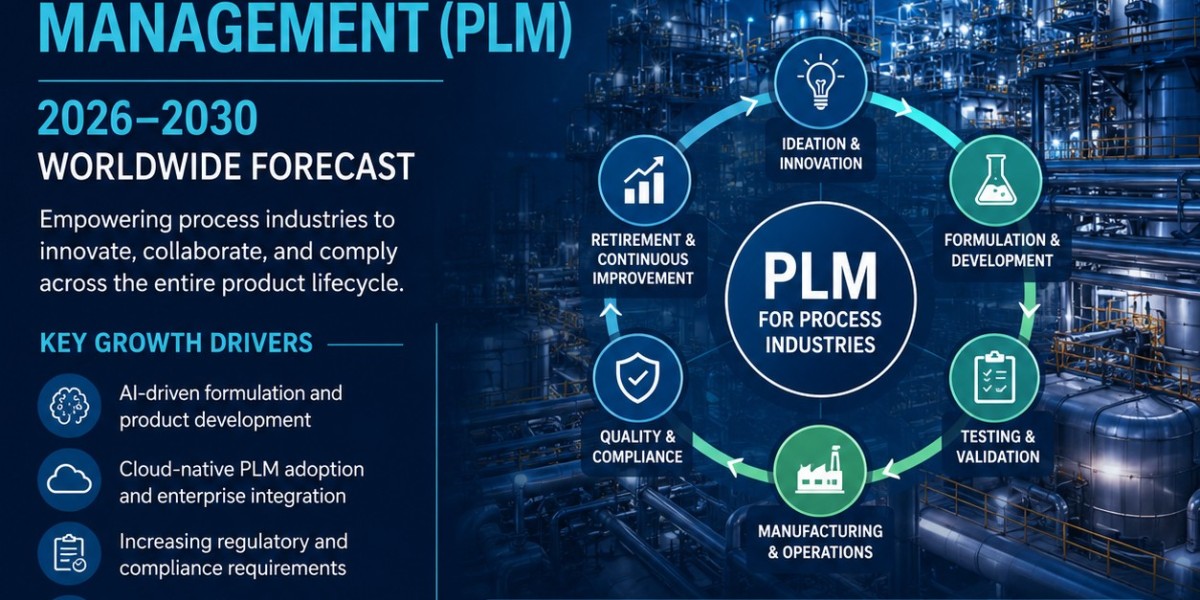

Digital transformation has fundamentally reshaped how organizations design, develop, and commercialize products. While discrete manufacturers have long relied on digital engineering platforms, process-intensive industries—including food and beverage, life sciences, chemicals, and personal care—are rapidly embracing Process Lifecycle Management (PLM) solutions to manage increasingly complex product development environments. According to QKS Group, the Process Lifecycle Management (PLM) Market is projected to reach $12.45 billion by 2030, expanding at a CAGR of 15.72% between 2026 and 2030.
This remarkable growth reflects a broader shift in the manufacturing landscape. Organizations are no longer focused solely on accelerating product launches; they are also under pressure to ensure regulatory compliance, improve product quality, enhance supply chain transparency, and respond quickly to evolving consumer demands. As product portfolios become more diverse and regulations continue to evolve, traditional methods of managing formulations, specifications, and product documentation are proving inadequate. PLM has emerged as a strategic platform that enables enterprises to manage every stage of the product lifecycle through a connected and data-driven approach.
Unlike traditional product data management solutions, Process Lifecycle Management platforms are specifically designed for formulation-based industries where ingredients, recipes, compliance documentation, quality standards, and packaging specifications are constantly changing. These platforms create a centralized digital environment where research and development, regulatory affairs, quality assurance, procurement, manufacturing, and supply chain teams can collaborate seamlessly using a single source of truth. This level of integration significantly reduces development cycles while improving product consistency and operational efficiency.
One of the primary drivers fueling the market is the growing complexity of global regulatory frameworks. Manufacturers must comply with diverse regional requirements related to product safety, labeling, environmental sustainability, and ingredient traceability. Manual compliance processes often introduce delays and increase the likelihood of costly errors. Modern PLM platforms automate documentation management, regulatory workflows, and change tracking, enabling organizations to maintain compliance while reducing administrative burdens. As governments continue introducing stricter quality and sustainability regulations, digital compliance capabilities have become a competitive necessity rather than an operational advantage.
Another significant factor contributing to market expansion is the increasing pace of product innovation. Consumer preferences are changing faster than ever, particularly in industries such as food, cosmetics, and healthcare. Organizations must continuously reformulate products, introduce healthier alternatives, incorporate sustainable ingredients, and adapt packaging to meet changing market expectations. PLM solutions provide collaborative development environments where cross-functional teams can evaluate formulations, manage product variants, track revisions, and accelerate approvals without compromising quality or compliance. This ability to shorten time-to-market while maintaining governance has become a critical differentiator for leading manufacturers.
The growing complexity of global supply chains is also reinforcing the importance of Process Lifecycle Management platforms. Today's manufacturers source ingredients and raw materials from multiple suppliers across different regions, making end-to-end visibility increasingly difficult. Supply disruptions, changing supplier certifications, and evolving sustainability expectations require organizations to maintain accurate, real-time product information throughout the value chain. PLM platforms improve traceability by connecting formulation data, supplier information, quality records, and manufacturing documentation into a unified ecosystem, enabling faster decision-making and reducing operational risk.
Artificial intelligence is further transforming the capabilities of modern PLM solutions. AI-powered analytics are enabling manufacturers to identify formulation improvements, predict product performance, recommend ingredient substitutions, and optimize development workflows based on historical data. Combined with machine learning, these capabilities reduce repetitive engineering tasks while providing actionable insights that improve innovation outcomes. Rather than replacing human expertise, AI enhances collaboration by enabling research and development teams to make faster, data-driven decisions throughout the product lifecycle.
Cloud adoption is another defining trend shaping the future of the PLM market. Organizations increasingly prefer cloud-native platforms because they offer greater scalability, lower infrastructure costs, improved accessibility, and faster deployment compared to traditional on-premises systems. Cloud-based PLM also enables distributed teams, suppliers, and external partners to collaborate securely from anywhere, supporting global product development initiatives. As hybrid work models become permanent across many enterprises, cloud deployment is expected to remain the preferred approach for new PLM investments.
Sustainability has also become deeply embedded within product lifecycle strategies. Manufacturers are expected to minimize environmental impact while maintaining profitability and regulatory compliance. Modern PLM platforms help organizations evaluate sustainable ingredients, monitor packaging materials, manage environmental documentation, and measure lifecycle impacts throughout product development. By embedding sustainability metrics directly into innovation processes, enterprises can align business objectives with environmental commitments while responding to increasing consumer demand for transparent and responsible products.
Despite its significant advantages, implementing a Process Lifecycle Management platform is not without challenges. Many organizations continue to operate with fragmented legacy systems that store product information across multiple departments. Integrating these systems, migrating historical data, and driving user adoption require careful planning and executive commitment. However, advancements in low-code configuration, AI-assisted automation, standardized integration frameworks, and cloud deployment models are significantly reducing implementation complexity, making PLM more accessible for organizations of all sizes.
Looking ahead, the future of the Process Lifecycle Management (PLM) Market will be shaped by deeper integration with enterprise technologies such as Enterprise Resource Planning (ERP), Manufacturing Execution Systems (MES), Laboratory Information Management Systems (LIMS), Quality Management Systems (QMS), and Industrial IoT platforms. This convergence will enable manufacturers to establish fully connected digital ecosystems where product development, manufacturing, quality, and compliance operate as an integrated business process rather than isolated functions. Emerging technologies such as digital twins, predictive analytics, and generative AI will further strengthen PLM's role in enabling intelligent product innovation and continuous improvement.
As organizations navigate increasing regulatory complexity, supply chain volatility, and rising customer expectations, Process Lifecycle Management is evolving from a product development application into a strategic enterprise platform. The projected market valuation of $12.45 billion by 2030 underscores the growing recognition that digital lifecycle management is essential for building resilient, compliant, and innovation-driven businesses. Enterprises that invest in modern PLM capabilities today will be better positioned to accelerate innovation, improve operational agility, and achieve sustainable competitive advantage in the years ahead.