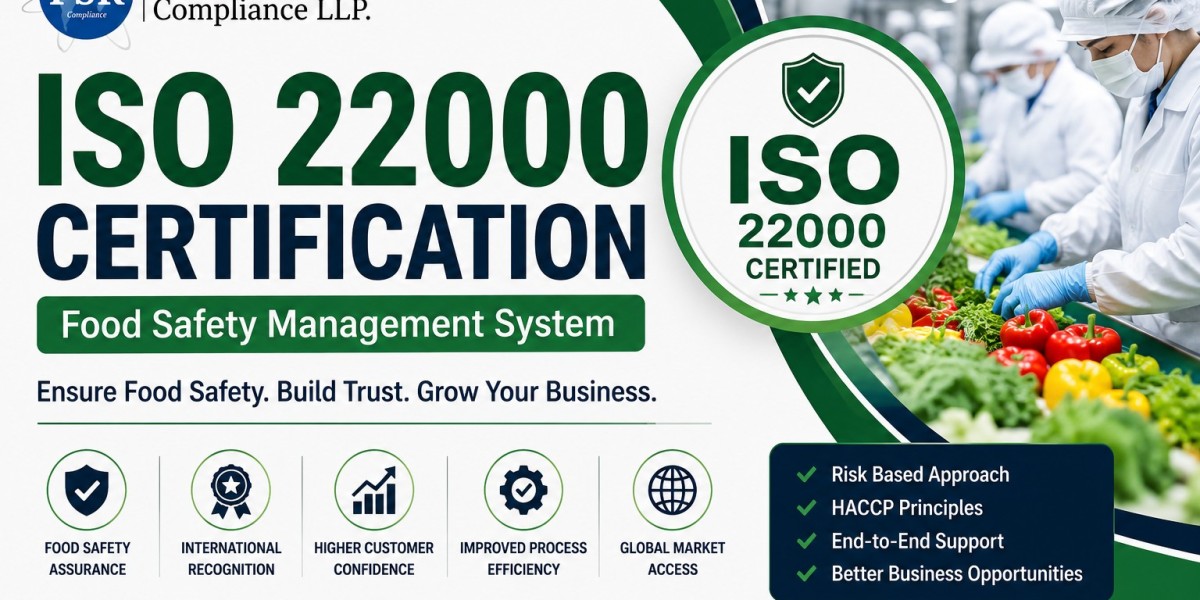

Imagine spending years building your food business only to lose customers because of a single food safety issue. Whether you run a restaurant, dairy, food manufacturing unit, cloud kitchen, packaging company, or export business, food safety is no longer optional—it's a necessity. Consumers today expect safe, hygienic, and high-quality food, while regulators and business partners demand proof that your products meet international food safety standards.
This is where ISO 22000 Certification becomes an important advantage.
ISO 22000 is a globally recognized standard that helps businesses establish a Food Safety Management System (FSMS) to identify, control, and prevent food safety risks throughout the supply chain. It enables organizations to maintain consistent food quality, comply with regulations, and build trust among customers and business partners.
If you're planning to apply for ISO 22000 Certification in India, this guide explains everything you need to know in simple language.
What is ISO 22000 Certification?
ISO 22000 Certification is an international standard developed by the International Organization for Standardization (ISO) for implementing a Food Safety Management System (FSMS).
The standard provides a structured framework that helps businesses identify food safety hazards, control risks, and ensure that food remains safe at every stage—from sourcing raw materials to production, storage, transportation, and final delivery.
Unlike basic food safety practices, ISO 22000 follows a preventive approach. Instead of solving problems after they occur, it focuses on identifying potential hazards in advance and implementing effective control measures.
This standard combines internationally accepted food safety principles, including Hazard Analysis and Critical Control Points (HACCP), with a management system that supports continuous improvement.
Simply put, ISO 22000 Certification helps businesses produce safer food while improving customer confidence and operational efficiency.
What is a Food Safety Management System (FSMS)?
A Food Safety Management System (FSMS) is a documented system that helps food businesses manage food safety risks in a planned and organized way.
Rather than relying only on inspections, an FSMS ensures that food safety is built into every step of the business process.
An effective Food Safety Management System typically includes:
Food Safety Policy
Hazard Identification
Risk Assessment
HACCP Implementation
Good Manufacturing Practices (GMP)
Hygiene and Sanitation Controls
Employee Training
Supplier Management
Product Traceability
Internal Audits
Corrective Actions
Continuous Improvement
Implementing an FSMS helps businesses maintain consistent product quality while reducing the risk of contamination and food safety incidents.
Why is ISO 22000 Certification Important in 2026?
The food industry is evolving rapidly, and customer expectations are higher than ever. Buyers want assurance that the food they consume is safe, hygienic, and produced under controlled conditions.
At the same time, food businesses must comply with regulatory requirements and maintain strong quality standards to remain competitive.
Obtaining ISO 22000 Certification helps businesses:
Improve food safety practices
Reduce contamination risks
Build customer confidence
Strengthen brand reputation
Improve operational efficiency
Meet customer and supply chain requirements
Support exports and international business
Promote continual improvement
For manufacturers, exporters, and food processing units, ISO 22000 can also increase business opportunities by demonstrating a commitment to internationally accepted food safety standards.
Who Should Apply for ISO 22000 Certification?
One of the biggest advantages of ISO 22000 is that it applies to every organization involved in the food supply chain.
Businesses that commonly obtain ISO 22000 Certification include:
Food Manufacturing Companies
Restaurants
Hotels
Cloud Kitchens
Catering Businesses
Dairy Processing Units
Beverage Manufacturers
Bakeries
Sweet Manufacturers
Spice Processing Units
Meat & Poultry Processing Units
Seafood Exporters
Cold Storage Facilities
Food Packaging Companies
Warehousing & Logistics Providers
Food Ingredient Suppliers
Agricultural Producers
Food Exporters
Retail Food Chains
Supermarkets
Whether your business is small or large, implementing a Food Safety Management System can improve customer trust and business performance.
Key Benefits of ISO 22000 Certification
Implementing ISO 22000 Certification offers more than just compliance. It creates a strong foundation for long-term business growth and food safety.
Improves Food Safety
The system helps identify and control food safety hazards before they become serious problems.
Builds Customer Trust
Customers are more likely to choose businesses that follow internationally recognized food safety standards.
Supports Regulatory Compliance
An effective Food Safety Management System helps organizations align with applicable food safety regulations and legal requirements.
Reduces Food Safety Risks
By monitoring critical processes, businesses can reduce contamination, product recalls, and food safety incidents.
Enhances Business Reputation
Certification demonstrates your commitment to quality and responsible food production, improving your credibility in the market.
Creates New Business Opportunities
Many retailers, exporters, and multinational companies prefer working with suppliers that have ISO 22000 Certification, making it easier to access new markets and long-term business partnerships.
ISO 22000 Requirements
Documents Required
Step-by-Step ISO 22000 Certification Process
Cost of ISO 22000 Certification in India
Validity of ISO 22000 Certificate
Common Mistakes to Avoid
Why Choose PSR Compliance
Conclusion
8 SEO-Optimized FAQs
This structure is written to satisfy both user intent and Google's AI Overview, while naturally using the target keywords without keyword stuffing.
part 2 bhi bna de faq conclussion
ISO 22000 Requirements
To obtain ISO 22000 Certification, an organization must establish a Food Safety Management System (FSMS) that effectively identifies, controls, and monitors food safety hazards. The standard focuses on risk-based thinking and continuous improvement to ensure safe food production throughout the supply chain.
The key ISO 22000 Requirements include:
Establishing a Food Safety Policy
Identifying food safety hazards
Conducting risk assessments
Implementing HACCP principles
Defining Operational Prerequisite Programs (OPRPs)
Monitoring Critical Control Points (CCPs)
Maintaining documented procedures
Ensuring employee training and awareness
Conducting internal audits
Taking corrective and preventive actions
Performing regular management reviews
Continuously improving the Food Safety Management System
These requirements help businesses build a proactive food safety culture instead of reacting to problems after they occur.
Documents Required for ISO 22000 Certification
The documentation requirements vary depending on the size and nature of the organization. However, most businesses generally require the following documents:
Certificate of Incorporation or Business Registration
GST Registration (if applicable)
PAN Card of the Business
Organization Chart
Food Safety Policy
Scope of Business Activities
HACCP Plan
Food Safety Manual (FSMS Manual)
Hazard Analysis Report
Standard Operating Procedures (SOPs)
Cleaning and Sanitation Procedures
Pest Control Records
Equipment Maintenance Records
Employee Training Records
Internal Audit Reports
Corrective Action Reports
Management Review Records
Emergency Response Plan
Maintaining accurate documentation helps demonstrate compliance during the certification audit.
Step-by-Step ISO 22000 Certification Process
Obtaining ISO 22000 Certification in India follows a structured process that ensures your Food Safety Management System complies with international standards.
Step 1: Business Assessment
The certification process begins by understanding your business activities, products, production process, and food safety risks.
Step 2: Gap Analysis
Experts compare your existing food safety practices with the ISO 22000 Standard to identify areas that need improvement.
Step 3: Documentation
A Food Safety Management System is developed, including policies, procedures, HACCP plans, records, and operational controls.
Step 4: Implementation
The documented system is implemented across the organization. Employees receive training on food safety practices and their responsibilities.
Step 5: Internal Audit
An internal audit is conducted to verify whether the Food Safety Management System is working effectively and to identify any non-conformities.
Step 6: Certification Audit
An accredited certification body conducts Stage 1 and Stage 2 audits to verify compliance with ISO 22000 Requirements.
Step 7: Certificate Issuance
After successfully completing the audit and closing any observations, the organization receives its ISO 22000 Certification.
How Much Does ISO 22000 Certification Cost in India?
The cost of ISO 22000 Certification in India depends on several factors, such as:
Size of the organization
Number of employees
Number of production locations
Nature of food products
Complexity of operations
Scope of certification
Readiness of the Food Safety Management System
Since every organization has different requirements, there is no fixed certification fee. A customized quotation is generally provided after assessing the business.
Validity of ISO 22000 Certification
An ISO 22000 Certificate is generally valid for three years, provided the organization successfully completes periodic surveillance audits conducted by the certification body.
Regular monitoring and continual improvement help maintain the certification throughout its validity period.
Common Mistakes to Avoid During ISO 22000 Certification
Many businesses face delays or non-conformities because of avoidable mistakes.
Some of the most common mistakes include:
Incomplete documentation
Poor implementation of HACCP
Lack of employee training
Improper record keeping
Failure to monitor Critical Control Points (CCPs)
Ignoring internal audits
Weak supplier evaluation process
Delayed corrective actions
Insufficient management involvement
Addressing these issues before the certification audit significantly improves the chances of successful certification.
Why Choose Universal PSR Compliance LLP?
Obtaining ISO 22000 Certification requires proper planning, documentation, implementation, and audit support. At Universal PSR Compliance LLP, we provide complete assistance to help businesses achieve certification efficiently.
Our Services Include:
Expert consultation
Gap Analysis
Complete documentation support
Food Safety Management System implementation
HACCP guidance
Internal audit assistance
Certification audit coordination
Post-certification support
Whether you are a food manufacturer, exporter, restaurant, cloud kitchen, dairy, or catering business, our experienced team helps simplify the entire certification process.
Contact Us
? Call: +91 8796104190
? Email: support@psrcompliance.com
? Website: https://www.psrcompliance.com
Conclusion
Food safety is one of the most important factors in building customer trust and ensuring long-term business success. ISO 22000 Certification provides a structured framework that helps organizations identify food safety risks, improve operational efficiency, and maintain consistent product quality across the entire food supply chain.
Whether you operate a small food business or a large manufacturing unit, implementing a Food Safety Management System demonstrates your commitment to producing safe, high-quality food while meeting international standards. Investing in ISO 22000 Certification can strengthen your brand reputation, improve compliance, and create new business opportunities in domestic and global markets.
If you're planning to obtain ISO 22000 Certification in India, Universal PSR Compliance LLP can guide you through every stage of the certification process with expert support and end-to-end assistance.
Frequently Asked Questions (FAQs)
1. What is ISO 22000 Certification?
ISO 22000 Certification is an international standard for establishing a Food Safety Management System (FSMS) that helps businesses manage food safety hazards effectively.
2. Who should apply for ISO 22000 Certification?
Any organization involved in the food supply chain, including manufacturers, restaurants, caterers, exporters, packaging companies, warehouses, and retailers, can apply.
3. Is ISO 22000 Certification mandatory in India?
No. ISO 22000 Certification is generally voluntary, but many customers, retailers, exporters, and international buyers prefer certified businesses.
4. How long does it take to get ISO 22000 Certification?
The timeline depends on the organization's size, documentation, and readiness. Most businesses complete the certification process within a few weeks to a few months.
5. What is the validity of ISO 22000 Certification?
The certificate is generally valid for three years, subject to successful surveillance audits.
6. What documents are required for ISO 22000 Certification?
Typical documents include the Food Safety Policy, HACCP Plan, FSMS Manual, SOPs, employee training records, internal audit reports, and corrective action records.
7. What are the benefits of ISO 22000 Certification?
It helps improve food safety, reduce contamination risks, enhance customer trust, strengthen brand reputation, support regulatory compliance, and increase business opportunities.
8. Can small food businesses apply for ISO 22000 Certification?
Yes. Startups, MSMEs, cloud kitchens, bakeries, restaurants, and other small food businesses can implement ISO 22000 based on the size and scope of their operations.