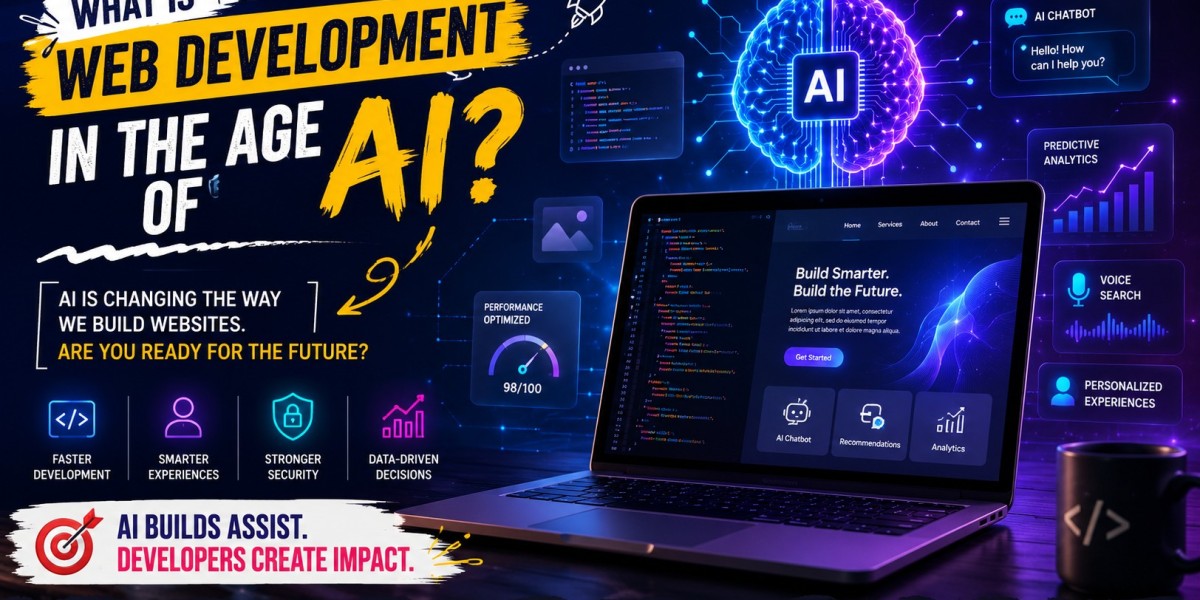

A decade ago, building a website meant writing thousands of lines of code, manually testing every feature, and spending weeks polishing the final product. Today, artificial intelligence is changing that process. For anyone wondering what is web development in today's digital world, the answer extends far beyond writing code. Developers can generate code in seconds, designers can create layouts with AI-assisted tools, and businesses expect websites that adapt to user behavior instead of simply displaying information.
What is web development in the age of AI? It is no longer just about creating websites. It is about building intelligent digital experiences that learn, automate, and improve over time. As AI-powered technologies become part of everyday digital products, websites are evolving into smart platforms capable of delivering personalized experiences, automating workflows, and making data-driven decisions in real time.
Despite the growing popularity of AI coding assistants, what is web development has become a more complex question than many expected. Instead of making development easier, AI has raised the standard for modern websites. Businesses now expect faster performance, stronger security, personalized user experiences, and built-in AI capabilities such as chatbots, recommendation engines, voice search, and predictive analytics. Understanding what is web development in the age of AI is essential for organizations looking to build websites that remain competitive and future-ready.
According to the Stack Overflow Developer Survey 2024, more than 76% of developers are using or planning to use AI tools in their daily workflow. The survey also highlights that AI is helping developers complete repetitive tasks faster while allowing them to focus on architecture, performance, and problem-solving rather than writing boilerplate code.
The shift is visible across nearly every industry. Retail brands now use AI to recommend products based on browsing behavior. Healthcare platforms provide AI-assisted symptom checkers before patients schedule appointments. Financial companies detect fraudulent transactions in real time using machine learning models connected directly to their web applications.
This evolution raises an important question.
How Has AI Changed Traditional Web Development?
Traditional web development followed a predictable path. Developers gathered requirements, designed the interface, wrote frontend and backend code, tested the application, and deployed it. Every stage relied heavily on manual effort.
That workflow still exists, but AI has introduced a faster and more intelligent layer into almost every step.
Modern development teams use AI-powered coding assistants to generate reusable components, identify bugs before deployment, and even suggest performance improvements. Instead of spending hours writing repetitive functions, developers can focus on solving complex business challenges and creating better user experiences.
AI is accelerating development, but it is not replacing the expertise required to build scalable, secure, and maintainable applications.
The difference becomes obvious in large projects. An eCommerce platform with thousands of products, multiple payment gateways, customer accounts, and inventory management still requires experienced developers to design system architecture, ensure security, and optimize performance. AI can assist throughout the process, but it cannot make strategic technical decisions on its own.
Another major change is personalization. Earlier websites delivered the same content to every visitor. AI-powered web applications can analyze browsing history, location, preferences, and user behavior to present content that feels relevant to each individual session.
That level of personalization has become a competitive advantage rather than a luxury.
As AI capabilities continue to evolve, web development is shifting from static website creation toward intelligent digital platforms that continuously learn and adapt to user needs.
Why AI Hasn't Replaced Web Developers?
The biggest misconception surrounding AI is that it can build complete websites without human involvement. While AI tools have become remarkably capable, they still operate within the boundaries set by developers. They generate code, suggest improvements, and automate repetitive tasks, but they don't understand long-term business goals, user psychology, or software architecture the way experienced engineers do.
Consider an online marketplace that handles millions of users. The platform must manage secure authentication, payment processing, inventory updates, third-party integrations, and data privacy regulations. These aren't isolated coding tasks. They are interconnected systems that demand careful planning and technical expertise.
AI can generate features. Developers build reliable products.
That's why businesses continue to invest in experienced web development teams even as AI tools become more advanced. Human developers evaluate trade-offs, optimize performance, maintain security standards, and ensure that every component works together as intended.
According to the GitHub Developer Survey, developers using AI coding assistants report significant productivity gains, especially when writing repetitive code and debugging common issues. However, experienced developers consistently spend that saved time reviewing AI-generated code, improving software quality, and solving complex engineering challenges rather than accepting AI output without verification.
What Does AI Actually Contribute to Web Development?
Artificial intelligence is becoming a practical assistant throughout the development lifecycle instead of acting as a replacement for developers.
Faster Code Generation
Writing boilerplate code has traditionally consumed a considerable amount of development time. AI-powered coding assistants can now generate API endpoints, UI components, validation logic, and database queries within seconds.
This allows developers to concentrate on application architecture and custom functionality instead of repetitive coding tasks.
Smarter Testing and Debugging
Testing has always been one of the most time-consuming phases of software development. AI tools can identify syntax errors, detect potential vulnerabilities, suggest optimizations, and even generate test cases before an application reaches production.
Finding bugs earlier reduces development costs and shortens release cycles.
Personalized User Experiences
Modern users expect websites to adapt to their interests. AI makes this possible by analyzing browsing behavior, previous interactions, purchase history, and engagement patterns.
Streaming platforms recommend content, eCommerce websites suggest relevant products, and SaaS platforms customize dashboards based on individual usage patterns. These personalized experiences improve customer satisfaction while increasing engagement and conversions.
Improved Website Performance
AI also helps optimize website performance by monitoring traffic patterns, predicting server loads, compressing assets intelligently, and identifying performance bottlenecks before they affect users.
Instead of reacting to slow-loading pages after complaints arrive, development teams can proactively improve website speed using AI-driven insights. Businesses partnering with an AI development company can take advantage of these capabilities to build faster, more scalable, and future-ready web applications.
In the age of AI, successful web development is defined less by how quickly code is written and more by how intelligently digital experiences are designed. As a trusted Software Development Company, Mtoag helps organizations create AI-powered websites and web applications that deliver exceptional performance, security, and user experiences.