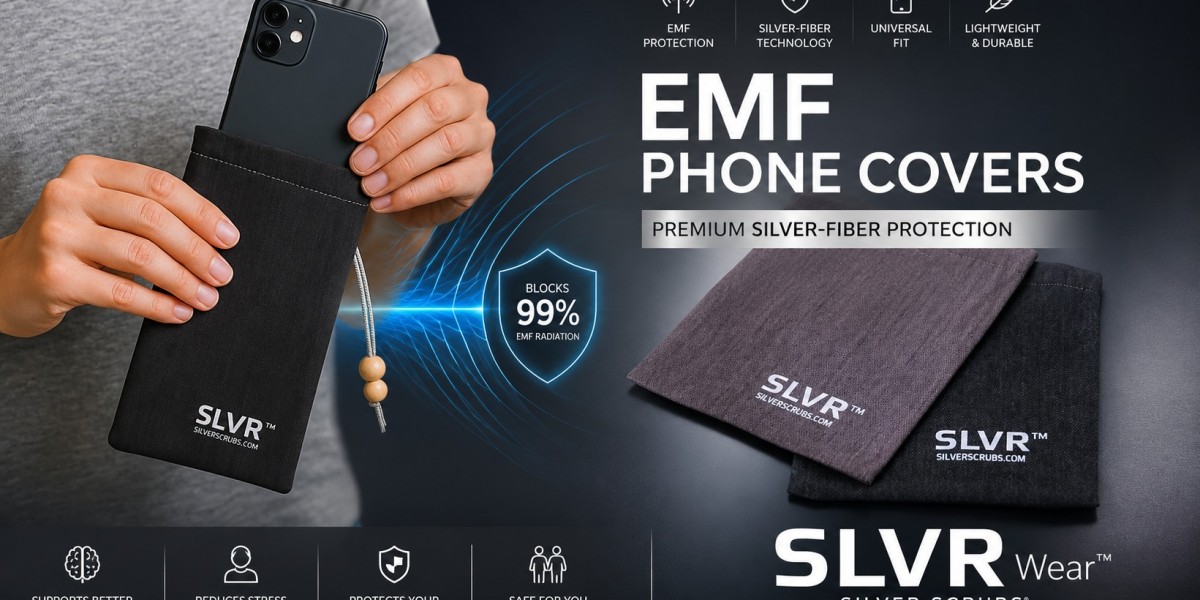

Most people encounter emf phone covers as a simple product decision, a pouch to slip a phone into. But underneath that simple decision is a fairly specific piece of material science, one that explains why some products genuinely interrupt a wireless signal and others do little more than look the part. Understanding that science does not require an engineering background. It comes down to a small number of physical principles, conductivity, enclosure, and weave density. Once those three ideas are clear, it becomes much easier to evaluate any emf blocking phone pouch on its actual merits rather than its marketing copy.
This article takes a closer look at the physics behind signal shielding, why silver specifically shows up so often in this category, and how that science translates into the everyday experience of using a pouch. Throughout, we will reference how SLVR Wear's Faraday Phone Pouch applies these same principles in a practical, wearable product.
The Physics of a Wireless Signal
A smartphone antenna sends and receives information by emitting and detecting radio frequency energy, a form of electromagnetic radiation. Cellular data, Wi-Fi, Bluetooth, and GPS each operate in slightly different frequency bands, but all of them rely on the same basic mechanism, an electromagnetic wave traveling from a transmitter to a receiver. When you place a call, stream a video, or check a map, that wave is physically passing between your phone and a tower, router, device, or satellite. An emf cover for phone use is designed to interrupt that wave before it can complete its path. It does this not through any electronic component of its own, but through a purely physical property of the material it's made from: electrical conductivity.
Why Conductive Materials Block Electromagnetic Waves
When an electromagnetic wave hits a conductive surface, the free electrons in that material respond to the wave oscillating electric field. In a sufficiently conductive material, this response effectively cancels the wave at the surface rather than letting it pass through a principle first documented by Michael Faraday, for whom this style of shielding enclosure is named. This is the same underlying concept used in shielded cables, some construction materials, and specialized rooms designed to block outside signals.
For a shielding effect to work on something as small and portable as a phone, the conductive material has to be thin, flexible, and capable of being formed into a pouch shape which rules out most metals in their solid form. Metal foil, for example, is conductive but impractical for daily use, it tears, creases permanently, and cannot be washed or folded repeatedly without breaking down. This is where fiber based conductive materials come in, and it's why the broader silver-fiber shielding fabric used across SLVR Wear™ product range was developed as a wearable alternative to rigid metal shielding, viewable at.
Why Silver, Specifically
Among conductive metals, silver has the highest electrical conductivity of any element. That property is what makes it useful here the more conductive a material is, the more effectively it interacts with an oscillating electromagnetic field, and the thinner a layer of it can be while still functioning as an effective shield. Copper and aluminum are also conductive and are used in other shielding contexts, but neither draws into as fine a fiber suitable for weaving into soft textile threads the way silver does.
In SLVR Wear's shielding fabric, silver fiber is woven directly into the fabric at a 35% ratio, alongside 59% polyester and 6% spandex, which keeps the material flexible and durable while maintaining enough conductive fiber throughout the weave to function as a shield. It's worth being precise about why silver appears in this conversation at all: its relevance here begins and ends with conductivity. Conductivity is a physical property, and it's the only reason silver fiber is part of this material.
Why Weave Density and Coverage Determine Real World Performance
Conductivity alone does not guarantee effective shielding; how the conductive fiber is distributed throughout the fabric matters just as much. A shield only works if the conductive threads form a continuous, sufficiently dense mesh across the entire surface of the pouch. Gaps in the weave, thin spots, or seams where the fabric does not fully overlap can all create paths for a signal to slip through, even if the fabric itself is made from a highly conductive fiber.
This is also why full enclosure matters so much for an emf pouch phone product. A conductive fabric with a gap at the opening is a bit like a fence with a missing panel. The material itself might be solid, but the barrier as a whole is not complete. A properly designed pouch accounts for this by using a flap or closure that fully overlaps the opening, extending the conductive mesh around the entire phone rather than leaving one side exposed.
How This Differs From a Standard Phone Case
It's worth stating plainly why an ordinary case has no shielding effect at all, even though it might look similar from the outside. Materials like plastic, silicone, and TPU are electrical insulators; they do not have the free moving electrons that conductive materials rely on to interact with an electromagnetic wave. A wave passing through an insulating material is not reflected or canceled; it simply continues on largely unaffected. This is why a standard case, no matter how well built for drop protection, does nothing to interrupt cellular, Wi-Fi, Bluetooth, or GPS signals the material itself is not equipped for that job.
The table below lays out this distinction at the material level
Property | Insulating Material (plastic, silicone) | Conductive Material (woven silver fiber) |
Free electron behavior | Electrons are tightly bound, minimal response to EM waves | Free electrons respond to and interact with EM waves |
Effect on radio-frequency signal | Signal passes through largely unaffected | Signal is intercepted at the material's surface |
Suitable for shielding | No | Yes, when woven with sufficient density and full coverage |
Common use in phone accessories | Drop and scratch protection | Blocking cellular, Wi-Fi, Bluetooth, and GPS signal |
Translating the Science Into a Practical Product
Understanding the physics helps explain a few practical things people notice once they start using an emf blocking bag for phone use. First, why full closure matters so much is not a minor design detail, it's the difference between a complete shield and a partial one. Second, why fabric quality and weave consistency matter more than most buyers initially expect, since the shielding effect depends entirely on the conductive mesh remaining intact across the fabric's surface. Third, why washing instructions matter, a woven conductive fiber, unlike a sprayed-on coating, is built into the fabric structure itself, which is part of why SLVR Wear's material remains machine washable and color stable without losing its function over normal use.
SLVR Wear's Faraday Phone Pouch applies each of these principles directly: a full-enclosure design built from woven silver fiber, engineered to block cellular, Wi-Fi, Bluetooth, and GPS signals while a phone is inside. The product specifications and construction details are available at.
Where the Same Material Science Shows Up Elsewhere
The same weaving principle of silver fiber worked directly into fabric threads to create a conductive mesh extending beyond phone accessories into wearable garments as well. SLVR Wear's Silver Scrubs® line uses this identical approach at a larger scale, applying the same conductive fiber woven into fabric method across full apparel pieces. Seeing the material used across garments rather than a small pouch can be a useful way to understand how consistent this construction method is across product types, and the collection is browsable at.
A Note on What This Science Does and Does not Support
It's worth being direct about the boundaries of what this material science actually demonstrates. Conductivity and shielding are physical, measurable properties related to how electromagnetic waves interact with a material's surface. They have nothing to do with claims about health outcomes, symptoms, or wellbeing, and nothing in the physics described here supports those kinds of claims. What the science does support is a specific, testable function: a sufficiently conductive, fully enclosing woven fabric interrupts cellular, Wi-Fi, Bluetooth, and GPS signal transmission to a phone placed inside it.
If You are Evaluating a Product, Ask About the Physics
Given everything above, a useful way to evaluate any emf protection cell phone pouch is to ask questions rooted in the physics rather than the marketing, What conductive material is used, and at what percentage? Is it woven into the fabric or coated on top? Does the enclosure design fully overlap when closed? These are not abstract questions; they map directly onto the three variables that actually determine whether a shielding product works, material conductivity, weave density, and complete coverage. You can browse SLVR Wear's full accessory lineup, including the Faraday Phone Pouch, at cell phone accessories to see how these specifications are presented for each product.
Final Thoughts
The appeal of emf phone covers often starts with a simple question, does this actually work? and the honest answer depends entirely on material science rather than branding. A genuinely conductive fiber, woven densely enough and enclosed fully enough, physically interrupts a radio frequency wave. Anything short of that, regardless of how a product is marketed, is not doing the same job. Understanding that distinction is the most useful tool a shopper can bring into this category.
Frequently Asked Questions(FAQs)
Why is silver used in EMF phone covers instead of another metal?
Silver has the highest electrical conductivity of any metal, and it can be drawn into fine fiber suitable for weaving into soft, flexible fabric, something rigid metals are not practical for.
Does the shielding effect come from the phone case material itself?
Yes, conductive materials like woven silver fiber interact with and interrupt electromagnetic waves at the fabric's surface, while insulating materials like plastic or silicone have no effect on signal.
Why does full enclosure matter so much for shielding to work?
Even a highly conductive fabric only forms a complete barrier if it fully surrounds the phone, including the closure. A gap or opening allows signals to pass through unaffected.
Is a woven conductive fiber better than a coated one?
A woven fiber is built into the fabric structure itself, which tends to hold up better through washing and regular handling than a coating applied to the surface.
Does this shielding technology have any health related function?
No,The material science described here relates only to electrical conductivity and signal interruption. It has no connection to health outcomes or wellness claims.
Is the Faraday Phone Pouch a medical device?
No, SLVR Wear™ products, including the Faraday Phone Pouch, are not medical devices and are not intended to diagnose, treat, cure, or prevent any disease.