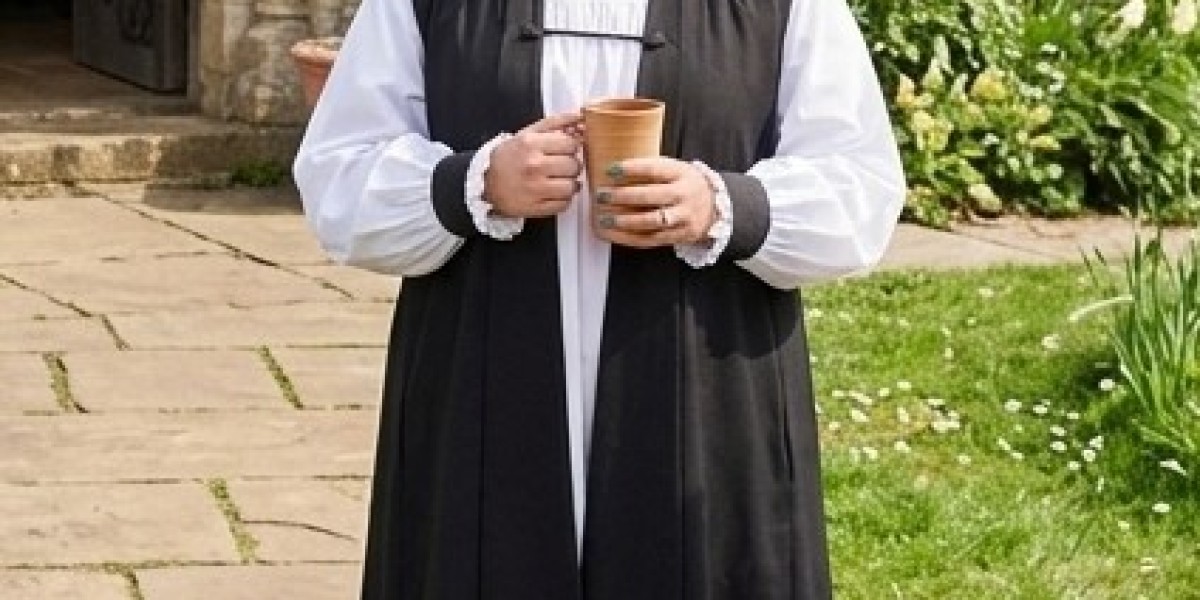

If you have ever attended an Eastern Orthodox liturgy after spending most of your church life in a Catholic, Anglican, or Protestant setting, one thing strikes you immediately.
The vestments look different. Completely different.
Not just in their richness, though that is striking on its own. But in their actual shape, their layering, their design details, and the way they relate to the liturgical seasons throughout the year.
Eastern Orthodox priest vestments are built on a theological and historical foundation that diverged from the Western tradition centuries ago and has developed its own distinctive visual language ever since.
This article explains the key differences between eastern orthodox priest vestments and the vestments worn in other major Christian churches, and why those differences matter.
What Is the Historical Root of Orthodox Vestment Differences?
Understanding why eastern orthodox priest vestments look so different from Catholic or Anglican vestments requires going back to the Byzantine Empire.
When the Byzantine Empire fell in 1453, the Eastern Orthodox Church inherited much of the imperial court's visual and ceremonial tradition. The elaborate brocaded fabrics, the ornate embroidery patterns, and even the crown-shaped headpieces worn by emperors were absorbed into the vestment tradition of Orthodox bishops and, over time, filtered into priestly vestments as well.
The Western Church, centered in Rome, followed a different historical trajectory. It underwent repeated liturgical reforms over the centuries, most significantly after the Second Vatican Council in the 1960s, which deliberately simplified many aspects of Catholic vestment design in favor of what the Council called noble simplicity.
The result is the striking visual contrast visible today. Eastern orthodox priest vestments retained and even intensified the imperial splendor of their Byzantine heritage. Western vestments, particularly in the post-Vatican II Catholic tradition, moved toward cleaner, simpler designs.
Why Did Orthodox Vestments Develop So Differently From Western Vestments?
The theological conviction behind Eastern Orthodox priest vestments is that the liturgy is a direct glimpse into heavenly glory, a genuine intersection of heaven and earth. If the liturgy is truly a participation in the worship of the heavenly kingdom, then the visual environment of the liturgy, including the vestments worn by the priests, should communicate something of that heavenly richness.
This theological vision required vestments that look nothing like everyday clothing. The brocades, the gold thread, the elaborate embroidery patterns, and the layered complexity of priestly vestments in the Orthodox tradition all serve this purpose. They communicate that what is happening during the divine liturgy belongs to a different order of reality than ordinary human experience.
What Is the Phelonion and How Does It Differ From the Catholic Chasuble?
The phelonion is the outermost vestment worn by Orthodox priests during the divine liturgy. It is the closest Orthodox equivalent to the Catholic chasuble, but it differs in several significant ways.
A Catholic chasuble is generally more or less symmetrical front and back, fully covering the priest in a flowing outer garment. Modern Catholic chasubles often have a clean, simplified shape as part of the post-Vatican II emphasis on simplicity.
The Orthodox phelonion has a more distinctive and asymmetrical form. In the Byzantine or Greek style, the phelonion fits over the shoulders in a generous, conical shape. In the Russian style, it features a high stiffened collar that rises behind the priest's head, creating a dramatic visual profile that has no parallel in Western vestment design.
What Does the Phelonion Symbolize?
The phelonion carries specific theological symbolism connected to the Passion of Christ. It is understood to represent the red tunic with which Pilate dressed Jesus before his crucifixion, transforming the most visible outer garment of the Orthodox priest into a direct visual reference to the suffering of Christ.
This is one of many examples of how eastern orthodox priest vestments function as theological teaching through visual design. The priest standing at the altar in his phelonion is not simply dressed for the occasion. He is wearing a garment that proclaims the central mystery of the faith before he speaks a single word. While these sacred vestments are distinct from female clergy clothes, both reflect the traditions, symbolism, and reverence associated with Christian ministry.
How Is the Epitrachelion Different From the Western Stole?
The stole is one of the most theologically significant garments worn by ordained ministers in virtually every Christian tradition. It represents the authority of ordained ministry and the yoke of Christ. But the way it is constructed and worn differs significantly between Orthodox and Western traditions.
In Catholic, Anglican, and most Protestant traditions, the stole is a simple strip of cloth, typically about four inches wide, worn around the neck and draped down the front of the body. A priest wears it draped straight down or crossed at the chest beneath the chasuble.
The Orthodox equivalent, called the epitrachelion, looks and functions quite differently. Rather than being a simple strip, the epitrachelion is a single piece of fabric with two parallel strips sewn together, creating a continuous loop that is placed around the neck. It extends all the way to the priest's ankles and typically features seven embroidered crosses, one at the back of the neck and three down each side.
What Does the Epitrachelion Represent?
Like the Western stole, the epitrachelion symbolizes the spiritual yoke of the priesthood and the double portion of God's grace bestowed upon the priest for the celebration of the divine mysteries.
Theologically, the fact that the two sides of the epitrachelion are sewn together is significant. It represents the unity of the priestly office as a single, continuous calling rather than a divided or partial authority. The priest cannot separate the two sides of his stole any more than he can divide the calling he received at ordination.
The epitrachelion is also the one liturgical vestment without which no Orthodox priest can perform any liturgical service. Even if he lacks every other piece of the vestment set, the epitrachelion is absolutely required.
What Are the Epimanikia and Why Are They Unique to Orthodox Vestments?
The epimanikia are the stiffened cuffs tied around the priest's wrists during the divine liturgy. This vestment has no direct equivalent in most Western traditions and is one of the most distinctive visual features of eastern orthodox priest vestments.
They serve a practical purpose, keeping the wide sleeves of the under-robe, the sticharion, out of the way during the physical actions of the liturgy, particularly when the priest is handling the sacred vessels at the altar.
What Do the Epimanikia Symbolize Theologically?
The theological meaning of the epimanikia goes well beyond the practical. These stiffened cuffs at the wrists serve as a constant physical reminder to the priest that he does not perform the sacraments by his own power or on his own authority.
The bonds around the wrists recall the bonds that tied the hands of Christ during his passion. Every time the priest reaches toward the altar in the celebration of the divine liturgy, the epimanikia remind him that his hands are instruments of God's grace rather than extensions of his own ability. The priest who wears these cuffs is performing the most sacred actions of the liturgy with bound hands, testifying that the power behind those actions comes from somewhere beyond himself.
This is a deeply characteristic Orthodox theological insight made visible through a vestment detail.
How Do Orthodox and Western Churches Differ in the Use of Liturgical Colors?
One of the most significant practical differences between eastern orthodox priest vestments and Western vestments for priests involves the use of liturgical colors throughout the church year.
Western traditions, particularly Catholic, Anglican, and Lutheran churches, follow a precisely regulated liturgical color calendar. Purple or violet is worn during Advent and Lent. White or gold is worn at Christmas, Easter, and other feast days celebrating Christ and the saints. Red is worn at Pentecost and on the feast days of martyrs. Green is worn during Ordinary Time.
This color calendar creates a visual rhythm throughout the year that helps the congregation identify the liturgical season simply by looking at the vestments.
How Do Orthodox Churches Handle Vestment Colors Differently?
Eastern orthodox priest vestments do not follow a universally prescribed annual color cycle in the same way that Western vestments do. Orthodox churches use colors such as gold, white, red, and blue for feast days and specific saints' days, but the specific color choices are more flexible and vary between different Orthodox jurisdictions and local traditions.
Gold is one of the most commonly worn colors in Orthodox liturgy regardless of the specific feast being celebrated, reflecting the tradition's emphasis on the heavenly glory that every liturgy is understood to represent.
This difference in color philosophy reflects a deeper theological divergence. Western liturgical colors are precisely calibrated to communicate the specific spiritual theme of each season. Orthodox vestment colors are more concerned with communicating the overall glory and majesty of heavenly worship at every liturgy.
How Do Orthodox Bishop Vestments Differ From Other Traditions?
The differences between Orthodox and Western vestments become even more pronounced at the level of the bishop's attire.
An Orthodox bishop wears a distinctive set of vestments that have no precise parallel in any Western tradition. The sakkos, a tunic with wide sleeves that replaced the phelonion as the standard bishop's outer vestment after the fall of Constantinople, is one of the most recognizable pieces. Traditionally, it incorporates bells along its hem, following the biblical instructions for the vestments of the Jewish High Priest described in Exodus 28.
The Orthodox bishop also wears a crown-shaped mitre fashioned after the imperial crown of the Byzantine Empire, a panagia medallion bearing the icon of the Theotokos, and an omophorion, a wide band worn over the shoulders that symbolizes the bishop's spiritual authority over his flock.
In contrast, Catholic bishops wear a simpler pointed mitre and carry a crozier staff, while Anglican bishops follow similar patterns with some variation. Neither Western tradition features the specific combination of panagia, sakkos, and the elaborate jeweled crown-mitre that characterizes Orthodox episcopal vestements.
How Does Understanding Orthodox Vestments Help Women in Ministry?
For women serving in Orthodox, Catholic, Anglican, or other ministry contexts, understanding the distinct vestment traditions of each church helps inform appropriate choices for female clergy clothes within their specific tradition.
Liturgical garments for women in ministry vary enormously between denominations, partly because of the same historical and theological differences that produced such different vestment traditions between East and West.
A female minister in an Orthodox-influenced tradition will look very different in her vestments from one serving in a simplified post-Vatican II Catholic context or a streamlined Protestant setting. Understanding the theological reasons behind those differences helps every woman in ministry make garment choices that are genuinely appropriate to her tradition rather than simply borrowing aesthetic elements from a context that does not fit her theological and liturgical home.
FAQ
How Is Eastern Orthodoxy Different From Christianity?
Eastern Orthodoxy is a major branch of Christianity, not separate from it. It shares core Christian beliefs but differs from Western Christianity in theology, liturgical practice, church governance, and the interpretation of church councils.
Is Tom Hanks an Orthodox Christian?
Tom Hanks converted to Greek Orthodoxy when he married his wife Rita Wilson, who is of Greek heritage, and has identified as an Orthodox Christian in various public statements.
Is Vladimir Putin an Orthodox Christian?
Vladimir Putin has publicly identified as a Russian Orthodox Christian and has spoken about his faith in various interviews, though the depth of his personal practice is a matter of public discussion.
Which Celebrities Are Orthodox Christians?
Notable Orthodox Christians include Tom Hanks, Olympia Dukakis, and various members of Greek, Russian, Serbian, and other culturally Orthodox communities. The faith is deeply embedded in the cultural heritage of many Eastern European and Middle Eastern populations.
Final Thoughts
Eastern orthodox priest vestments are not simply a more elaborate version of what Catholic or Anglican priests wear. They are the product of a completely different theological vision, a different historical trajectory, and a different understanding of what the liturgy is and what the priest's role within it should visually communicate.
The phelonion that recalls Christ's garment of suffering. The epitrachelion sewn into a continuous loop representing unified priestly authority. The epimanikia that bind the priest's wrists in humble testimony that he acts by God's power and not his own. All of these details tell a theological story that is distinctively Orthodox.
Whether you are a theology student, a parishioner, or someone shopping for liturgical vestments for your own ministry context, understanding these differences deepens appreciation for the rich diversity of sacred dress across the whole spectrum of Christian tradition.
Explore eClergy's full collection of priest vestments, liturgical vestments, clergy vestments, vestments, and complete female clergy clothes and liturgical garments built to honor every tradition's sacred calling with dignity and faithfulness.