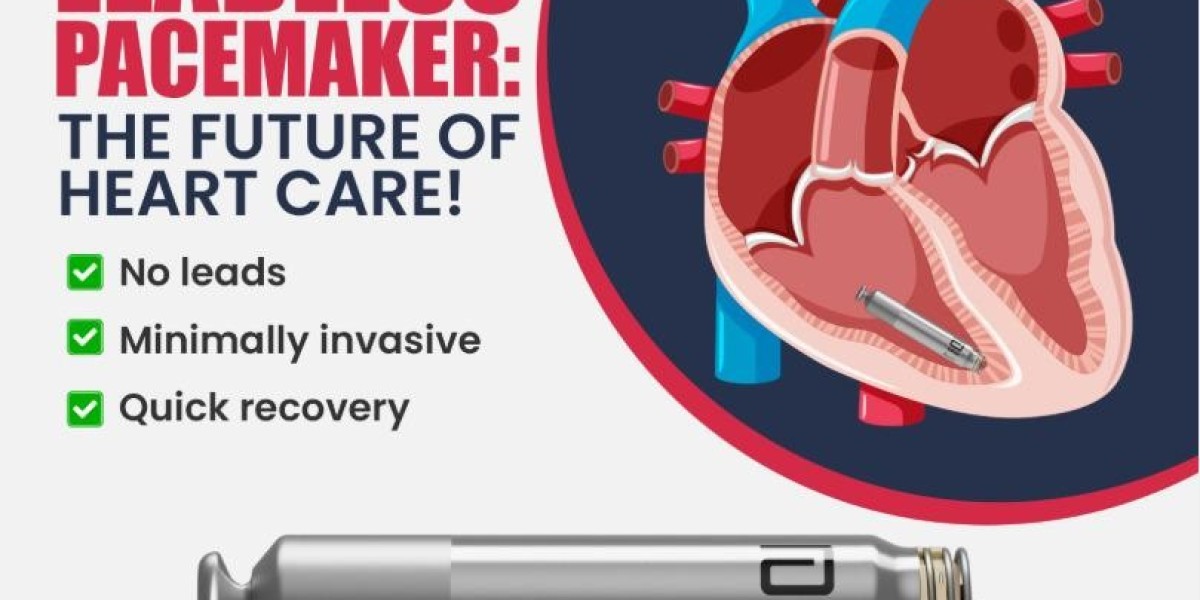

If you or a family member has just been told you need a pacemaker, you've probably come across a newer term in your research: the leadless pacemaker. It's smaller, it skips the wires, and it's changing how doctors treat slow heart rhythms in India. But what does it actually involve, and how much does it cost? This guide breaks it down in plain language: what the device is, how the procedure works, what it costs in India, who it's suitable for, and how to find the right doctor to perform it.
What Is a Leadless Pacemaker?
A traditional pacemaker has two parts: a pulse generator placed under the skin near the collarbone, and thin wires (leads) that run from the generator into the heart. A leadless pacemaker removes the wires and the pocket entirely. It's a single, self-contained device, roughly the size of a large vitamin capsule, placed directly inside the heart's right ventricle through a vein in the leg, avoiding many complications tied to conventional leads and pockets, such as infections and lead fractures.
Leadless vs. Traditional Pacemaker: The Key Differences
- No chest incision or visible scar - the device goes in through the femoral vein
- No leads, so no risk of lead dislodgement or fracture
- Shorter procedure and recovery time for most patients
- No arm or shoulder movement restrictions, unlike traditional devices
- MRI-compatible in most current models
That said, it isn't automatically "better" for everyone, it depends on your specific heart rhythm condition, which your cardiologist will assess.
The Leadless Pacemaker Procedure: Step by Step
The implantation is done in a cardiac catheterisation lab, usually under local anaesthesia with sedation rather than general anaesthesia.
- A small puncture is made in the femoral vein (upper thigh)
- A catheter carrying the pacemaker is guided to the right ventricle using live X-ray (fluoroscopy) imaging
- The device is positioned against the heart wall and secured using small tines or a screw-in mechanism
- The doctor performs a "tug test" to confirm it's firmly anchored
- The catheter is withdrawn and the puncture site closed
Most procedures take 45 minutes to about 1.5 hours, with discharge typically within 24 to 48 hours.
Who Is a Good Candidate for a Leadless Pacemaker?
Leadless pacemakers are generally recommended for patients who need single-chamber pacing, most often for bradycardia (a persistently slow heart rate), certain types of AV block, or atrial fibrillation with slow heart rates.
They may be a particularly good option for patients with a previous pocket infection, difficult venous access, or a higher infection risk (such as those on dialysis). They're generally not suitable for patients who need dual-chamber pacing in the traditional sense, have a mechanical tricuspid valve, or have an existing IVC filter; your cardiologist will confirm this after reviewing your ECG, echo, and overall heart rhythm pattern.
Leadless Pacemaker Cost in India
Cost is one of the most-searched questions on this topic, and the honest answer is: it varies. Based on current pricing across major Indian cardiac centres, a leadless pacemaker implantation typically costs between ₹6 lakh and ₹15 lakh, depending on:
- The device brand and model used (e.g., single-chamber vs. dual-chamber-capable leadless systems)
- The hospital's location and infrastructure
- Length of hospital stay
- Whether any additional cardiac procedures are needed at the same time
This is higher than a conventional single-chamber pacemaker, largely due to the technology and import costs involved. Many health insurance policies cover pacemaker implantation, including leadless systems, subject to device sub-limits, it's worth getting pre-authorisation and confirming the exact cost with the hospital beforehand.
Recovery and Life After a Leadless Pacemaker
Recovery is generally quicker than with a traditional pacemaker. Most patients resume normal daily activities within a few days, with only minor restrictions on strenuous activity for a couple of weeks, and no arm-movement restrictions since there's no generator pocket to protect. Regular follow-up checks are still needed to monitor battery life and pacing function, as with any pacemaker.
How to Choose the Best Doctor for a Leadless Pacemaker in India
Because leadless pacemaker implantation is still newer and more specialised than conventional pacemaker surgery, the doctor's hands-on experience matters significantly. When evaluating cardiologists, look at their procedure volume (how many leadless pacemakers they've personally implanted), hospital infrastructure (a modern cath lab with access to systems like Micra and AVEIR), experience with complex or revision cases (e.g., replacing an infected traditional pacemaker with a leadless one), and their post-implant follow-up systems, including remote monitoring.
Why Patients Choose Dr. Viveka Kumar for Leadless Pacemaker Implantation
Dr. Viveka Kumar, Chairman of Cardiology at Max Super Speciality Hospital, Saket, is among the interventional cardiologists in India with direct, hands-on experience implanting leadless pacemakers, including dual-chamber AVEIR systems in complex cases such as device infections and pocket revisions. His practice combines structural heart expertise with cardiac rhythm management, so patients are evaluated for the full range of pacing options, not just whichever device a hospital happens to stock.
If you've been advised to get a pacemaker and want to understand whether a leadless system is right for you, a detailed consultation is the best next step.
FAQs
1. Is a leadless pacemaker safe?
Ans: Yes. Clinical data shows leadless pacemakers have a safety profile comparable to, and in some respects better than, traditional pacemakers, particularly around infection risk. As with any implant procedure, your doctor will review your specific risks beforehand.
2. How long does a leadless pacemaker battery last?
Ans: Typically 8 to 17 years, depending on the device and how often it's used. When the battery runs low, a new device is usually implanted alongside the old one rather than requiring removal.
3. Is the leadless pacemaker procedure painful?
Ans: The procedure is done under local anaesthesia with sedation, so patients don't feel pain during the implantation. Some mild soreness at the puncture site in the thigh is normal for a day or two afterward.
4. Can I have an MRI scan after getting a leadless pacemaker?
Ans: Most current leadless pacemaker models are MRI-conditional, meaning MRI scans are generally safe under specific settings. Always inform your radiologist and cardiologist about your device before any scan.
5. Is leadless pacemaker surgery covered by insurance in India?
Ans: Many comprehensive policies cover it, though coverage depends on your device cap and waiting-period clauses. Confirm with your insurer and get pre-authorisation before the procedure.
6. How do I know if I need a leadless pacemaker instead of a traditional one?
Ans: It depends on your heart rhythm diagnosis, pacing needs, and device history. An ECG, echocardiogram, and consultation with a cardiac electrophysiologist or interventional cardiologist will determine the right option for you.