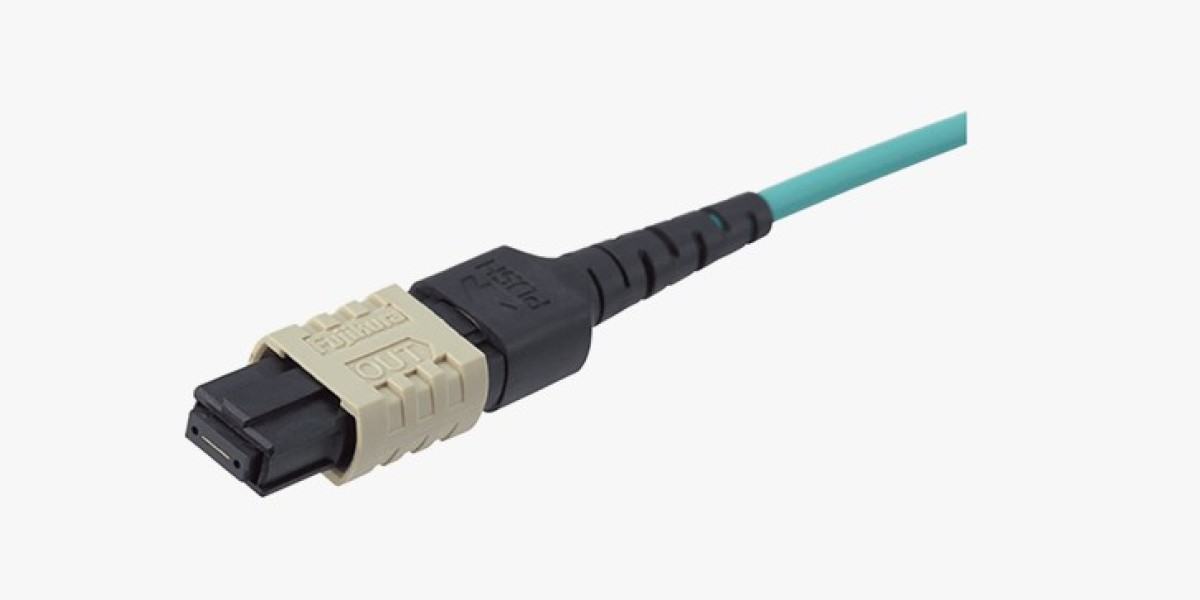

In today’s high-speed digital environment, efficient and scalable connectivity is essential for data centers, telecom systems, and enterprise networks. The MPO connector (Multi-fiber Push-On) is a key innovation in fiber optic technology, designed to support multiple fiber connections in a single compact interface.
It is widely used in high-density network environments where speed, reliability, and space efficiency are critical.
What Is an MPO Connector?
An MPO connector is a multi-fiber optical connector that allows multiple fibers—typically 8, 12, 16, 24, or more—to be connected simultaneously. Instead of connecting individual fibers one by one, MPO connectors bundle them into a single plug-and-play interface.
This design significantly reduces installation time and improves cable management in complex networks.
How MPO Connector Works
The MPO connector uses precision-aligned guide pins and a push-pull mechanism to ensure accurate alignment of all fiber strands.
When two MPO connectors are mated, all fibers connect at once, enabling parallel optical transmission. Each fiber carries its own data stream using light signals, allowing extremely high bandwidth and low-latency communication.
This makes MPO connectors ideal for modern high-performance networking systems.
Structure of MPO Connector
A typical MPO connector consists of several key components:
Ferrule
A precision component that holds and aligns multiple fiber cores.
Guide Pins
Ensure accurate alignment between male and female connectors.
Housing
Protects internal components and provides mechanical stability.
Spring Mechanism
Maintains pressure for secure and stable connection.
Latch System
Enables easy push-pull insertion and removal.
Types of MPO Connectors
There are several types of MPO connectors used in different applications.
Male MPO Connector
Contains guide pins for alignment.
Female MPO Connector
Does not include pins and relies on male connectors for alignment.
Single-Mode MPO Connector
Used for long-distance, high-speed transmission.
Multi-Mode MPO Connector
Used for short-range, high-bandwidth applications.
APC MPO Connector
Angled design for reduced back reflection.
UPC MPO Connector
Flat polish for low insertion loss.
Key Benefits of MPO Connector
The MPO connector offers several advantages in modern fiber optic systems.
High-Density Connectivity
Supports multiple fibers in a single compact interface.
Faster Installation
Plug-and-play design reduces installation time significantly.
Reduced Cable Clutter
Minimizes the number of individual fiber connections.
High Performance
Supports low-loss, high-speed data transmission.
Scalability
Easily supports network expansion and upgrades.
Applications of MPO Connector
MPO connectors are widely used in high-performance networking environments.
Data Centers
Used for server-to-switch and switch-to-switch connections.
Cloud Computing Systems
Supports high-speed distributed computing infrastructure.
Telecommunications Networks
Forms part of backbone fiber optic systems.
5G Infrastructure
Enables high-capacity backhaul connections.
Enterprise Networks
Supports internal high-speed communication systems.
MPO Connector in Data Centers
Data centers rely heavily on MPO connectors due to their efficiency and scalability.
High Port Density
Allows many fiber connections in limited rack space.
Simplified Upgrades
Supports migration to 40G, 100G, 400G, and beyond.
Reduced Downtime
Plug-and-play design minimizes service interruptions.
Efficient Cable Management
Keeps cabling organized and structured.
MPO Connector vs Traditional Fiber Connectors
MPO connectors offer significant improvements over traditional connectors.
Multi-Fiber Capability
Traditional connectors handle one fiber at a time; MPO handles many.
Installation Speed
MPO is significantly faster to deploy.
Space Efficiency
Reduces physical space required for cabling.
Performance Consistency
Factory-terminated connectors ensure higher reliability.
Installation of MPO Connector
Proper installation is critical for performance.
Clean the Connector
Dust or contamination can affect signal quality.
Align Guide Pins
Ensure correct male/female pairing.
Connect Carefully
Use push-pull mechanism for secure connection.
Test After Installation
Verify signal strength and continuity.
Challenges of MPO Connector Systems
Despite advantages, there are some challenges.
High Precision Requirement
Requires accurate alignment for optimal performance.
Cleaning Sensitivity
Contamination can impact signal transmission.
Compatibility Issues
Must match MPO standards and equipment.
Higher Cost
More expensive than traditional connectors.
Best Practices for MPO Connectors
To ensure long-term performance:
Always Clean Before Use
Use proper fiber cleaning tools.
Avoid Physical Stress
Do not bend or twist connectors excessively.
Maintain Proper Polarity
Ensure correct fiber alignment.
Label Connections
Helps with maintenance and troubleshooting.
Perform Regular Testing
Ensures stable and reliable performance.
Future of MPO Connector Technology
MPO technology continues to evolve with network demands.
Higher Fiber Counts
Future connectors will support more fibers per interface.
Support for 800G Networks
Designed for ultra-high-speed communication systems.
Improved Mechanical Design
Enhanced durability and lower insertion loss.
AI-Driven Data Centers
Supports automated and intelligent infrastructure systems.
Conclusion
The MPO connector is a critical component in modern fiber optic networks, enabling high-density, high-speed, and scalable connectivity. It is widely used in data centers, telecom systems, cloud infrastructure, and enterprise networks.
By simplifying installation, improving performance, and supporting next-generation bandwidth requirements, MPO connectors play a vital role in building the future of global digital communication systems.