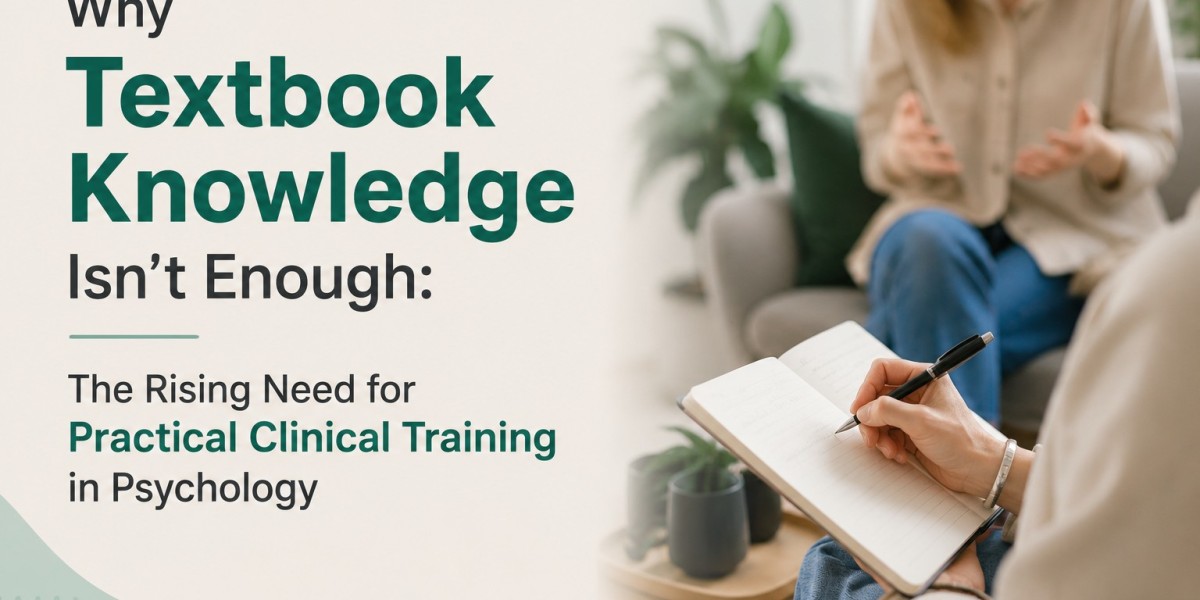

For decades, the path to becoming a psychologist has been heavily paved with thick textbooks, theoretical frameworks, and intense academic examinations. Students spend years memorizing the diagnostic criteria of the DSM-5, understanding different personality theories, and analyzing historical case studies.
While this strong academic foundation is absolutely essential, a growing concern within the mental health community is the widening gap between classroom learning and real-world clinical application. Textbooks give you the map, but they don't teach you how to navigate the rough terrain of actual human emotions.
The Reality Check: Classroom vs. Clinic
The reality of mental health practice hits hard the moment a graduate sits across from an actual client for the first time. In a real clinical setting, a client does not present their struggles in neat, textbook chapters. They come with complex, overlapping emotions, family histories, and deep-seated traumas that cannot be resolved simply by following a generic theoretical script.
When students transition from theory to practice, they quickly realize that clinical psychology is as much an art as it is a science. There are several critical elements that a textbook simply cannot teach:
Reading Non-Verbal Cues: Understanding a client's body language, sudden changes in tone, or a heavy silent pause.
Building Therapeutic Rapport: Learning how to make a vulnerable individual feel safe and heard without passing judgment.
Handling Unpredictable Responses: Knowing what to do when a client becomes highly emotional, defensive, or completely non-communicative during a session.
Core Skills Every Aspiring Psychologist Must Master
To build a successful and ethical career in mental health, a student needs to step out of the lecture halls and gain hands-on experience in core clinical procedures. Relying solely on memorized notes often leads to imposter syndrome and a lack of professional confidence.
Quick Fact: In clinical psychology, a wrong diagnosis due to lack of practical exposure can completely derail a client’s treatment plan. Live supervision is the only shield against such clinical errors.
If you want to practice independently in the future, your practical training must cover these essential building blocks:
Comprehensive History-Taking: Learning how to ask the right questions to extract relevant developmental, medical, and psychological histories.
Mental Status Examination (MSE): Developing the observational skills needed to assess a client's psychological functioning in real-time.
Advanced Case Conceptualization: Putting all the pieces of a client’s history together to formulate an accurate diagnosis and a customized treatment plan.
Ethical Boundary Management: Understanding client confidentiality and learning how to maintain emotional objectivity under stress.
Bridging the Gap with Expert Mentorship
Ultimately, the transformation from a psychology student to a confident practitioner requires a structured, supervised environment where errors can be corrected by experts before they affect a client.
This is exactly where specialized clinical environments play a vital role. For instance, Existence Clinics is actively bridging this academic-practical divide by providing extensive training grounds for students. Through the tailored clinical psychology internship program at Existence Clinics, aspiring therapists get a rare opportunity to learn directly under seasoned, RCI-licensed professionals.
Whether you are pursuing a BA, BSc, MA, or MSc in Psychology, engaging in live case discussions and getting practical insights under expert supervision is what transforms textbook concepts into life-changing career skills.
Final Thoughts
The future of mental health care depends heavily on how well we prepare the next generation of therapists. Relying solely on textbooks limits a student's potential and delays their professional growth. By prioritizing practical clinical training alongside university education, we can ensure that upcoming psychologists possess not just the degrees on their walls, but the genuine confidence, ethical grounding, and practical expertise required to truly change lives.