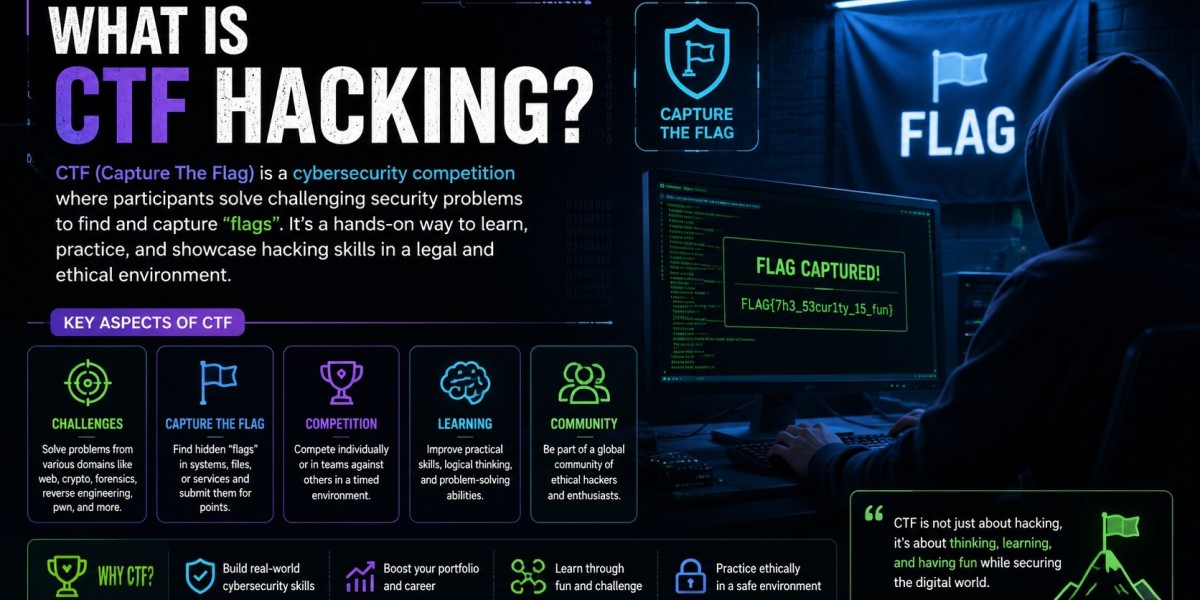

CTF hacking, short for Capture The Flag, is a form of competitive cybersecurity where participants solve technical challenges to find hidden text strings called flags. Each flag proves you have exploited a vulnerability, decoded a cipher, or cracked open a binary. Flags are submitted for points and the team or individual with the highest score wins. CTF hacking is legal, structured and designed to build real offensive and defensive security skills in a safe environment.
What Is CTF Hacking, Really?
Most people first encounter the term "CTF" in a security forum, a LinkedIn job post, or a recruiter wishlist and walk away with a vague sense that it has something to do with hacking. The reality is more specific and a lot more interesting.
CTF stands for Capture The Flag. The name borrows from the classic outdoor game where two teams try to steal each other's flag without getting tagged. In cybersecurity, the format works almost identically except instead of sprinting across a field, you're reverse-engineering a binary, injecting SQL into a login form, or decoding a base64 encoded secret hidden inside a PNG file.
What makes CTF hacking different from just reading about cybersecurity is the doing. You cannot learn how SQL injection works by studying a definition. You learn it by actually exploiting a deliberately vulnerable application under time pressure, with no hints and only your knowledge, your tools and your judgment standing between you and that flag. That gap between knowing and doing is exactly what Capture The Flag hacking is designed to close.
The competitive format emerged from the hacker conference scene in the mid-1990s, with early events at DEF CON in Las Vegas serving as the origin point. What started as an elite underground competition has grown into one of the most democratized entry points in all of cybersecurity. Today, students, career changers, developers, professional penetration testers and government security teams all compete in CTF events and the skill transfer is real in every direction.
How CTF Hacking Works: The Core Mechanics
Understanding how CTF hacking actually works requires breaking it into three layers: the event structure, the challenge categories and the scoring system.
The Event Structure
CTF competitions typically run on a fixed duration schedule anywhere from 24 hours to a full weekend. Some platforms always offer practice environments with no timer. The two most common formats are:
Format | Description | Best For |
Jeopardy-style | Individual challenges across categories; solve any, in any order | Beginners and self directed learners |
Attack-Defense | Teams defend their own services while attacking opponents | Advanced players; teamwork intensive |
King of the Hill | Teams compete to control a single target machine | Intermediate to advanced |
Boot2Root | Compromise a full machine from initial access to root | Penetration testing practice |
For anyone asking how CTF hacking works at the beginner level, Jeopardy-style is the right starting point. You pick the challenge category you want to practice, work at your own pace and learn without the pressure of active adversaries.
The Challenge Categories
CTF challenges map directly onto real-world security skill areas. The categories you'll encounter most often are:
Web Exploitation Attack intentionally vulnerable web applications. Challenges include SQL injection, cross-site scripting (XSS), server-side request forgery (SSRF), authentication bypass, insecure direct object references (IDOR) and more. This category is the most beginner-accessible and maps most directly to professional application security work.
Cryptography: Break ciphers, crack hashes, exploit weak random number generation, or find flaws in custom encryption schemes. Understanding cryptographic primitives is crucial to real-world security engineering.
Forensics Analyze disk images, packet captures, memory dumps, log files and corrupted files to extract hidden data or reconstruct attacker activity. Digital forensics challenges build investigative instincts that translate directly to incident response work.
Reverse Engineering Disassemble compiled binaries, understand undocumented software and figure out what a program does without access to its source code—a foundational skill for malware analysis and vulnerability research.
Binary Exploitation (Pwn) Exploit memory corruption vulnerabilities like buffer overflows, format string bugs and use-after-free conditions to take control of running processes. This is the most technically demanding category and requires understanding low-level systems programming.
OSINT Use open-source intelligence gathering techniques to find information about targets from publicly available data. Challenges train reconnaissance tradecraft used in real penetration testing engagements.
Miscellaneous Puzzles, steganography, trivia, scripting challenges and anything that doesn't fit neatly into another category. Often, a good warm-up category for beginners.
The Scoring System
Every solved challenge earns a point value proportional to its difficulty. Some competitions use dynamic scoring, where a challenge's point value decreases as more teams solve it so first blood on a hard challenge is worth significantly more than being the hundredth team to crack an easy one. The team or player with the most cumulative points at the end of the event wins.
Why CTF Hacking Builds Skills That Certifications Cannot
This is a question worth answering directly, because the cybersecurity certification industry is enormous and its products are not without value. The honest answer is that CTFs and certifications do different things.
Certifications verify that you understand a domain of knowledge. A CompTIA Security+ holder can explain what a firewall does, what the OSI model is and why patch management matters. That knowledge is genuinely useful.
CTF hacking verifies that you can apply offensive and defensive techniques under pressure. A player who has solved 300 web exploitation challenges knows, viscerally, how an attacker thinks when they approach a login form, an API endpoint, or a file upload function. They've felt the click of understanding when a payload finally works. They've built the muscle memory of methodology.
The data reflects this. A 2022 report by (ISC)² found that 70% of cybersecurity professionals cited practical, hands-on experience as the most important factor in career readiness ahead of formal qualifications. Employers increasingly agree. Organizations, including Google, HackerOne and major defense contractors, have incorporated CTF performance into their hiring criteria precisely because it reveals problem solving ability and technical depth in ways a multiple-choice exam cannot.
Beyond hiring, CTF hacking builds a specific kind of security intuition: the ability to look at a running application and identify where its trust assumptions might be wrong. That intuition is what separates a security professional who spots a vulnerability in a code review from one who misses it.
The CTF Hacking Skill Stack: What You Actually Need to Learn
One of the most common mistakes beginners make is treating CTF hacking as a single monolithic skill to be learned all at once. It isn't. CTF hacking is an aggregate of underlying technical competencies, each of which can be developed independently and progressively.
Here is a practical skill ladder for getting started:
Layer 1: The Foundation (Week 1–4)
Linux command line basics navigation, file permissions, text processing with grep/sed/awk, scripting fundamentals
Networking fundamentals TCP/IP, HTTP request/response structure, DNS, how web applications communicate
Basic scripting Python is the CTF community lingua franca; you don't need to be a developer, but you need to be able to write a 20 line script that automates a request.
Layer 2: Web Security Fundamentals (Month 1–3)
The OWASP Top 10 vulnerability classes SQL injection, XSS, broken access control, SSRF and the rest
How browsers interpret HTML, JavaScript and cookies
How to use Burp Suite to intercept, modify and replay HTTP requests
How authentication systems work and how they break
Understanding web exploitation is the fastest path from zero to first flag. Web challenges require accessible tooling, give immediate visual feedback and mirror the vulnerabilities that professional penetration testers find in real applications every day. If you want to understand web application penetration testing at a fundamental level, web CTF challenges are where that understanding gets built.
Layer 3: Specialty Domains (Month 3–6)
Once you have the foundation and web security basics, you choose where to specialize based on your career goals:
Career Target | CTF Category to Prioritize |
Penetration Tester / Red Teamer | Web Exploitation, Pwn, OSINT |
Application Security Engineer | Web Exploitation, Cryptography, Source Code Review |
Malware Analyst | Reverse Engineering, Forensics |
Incident Responder | Forensics, OSINT |
Security Researcher | Pwn, Reverse Engineering, Cryptography |
CTF Hacking vs. Real World Penetration Testing: The Connection
A question that comes up constantly in beginner communities: Is CTF hacking actually relevant to real penetration testing, or is it just a game?
The honest answer is both. CTF challenges are intentionally artificial; they are designed to be solvable, have clean solutions and exist within a defined scope. Real penetration testing engagements involve messy, undocumented systems, unclear scope boundaries, client communication and written deliverables. The experience is not identical.