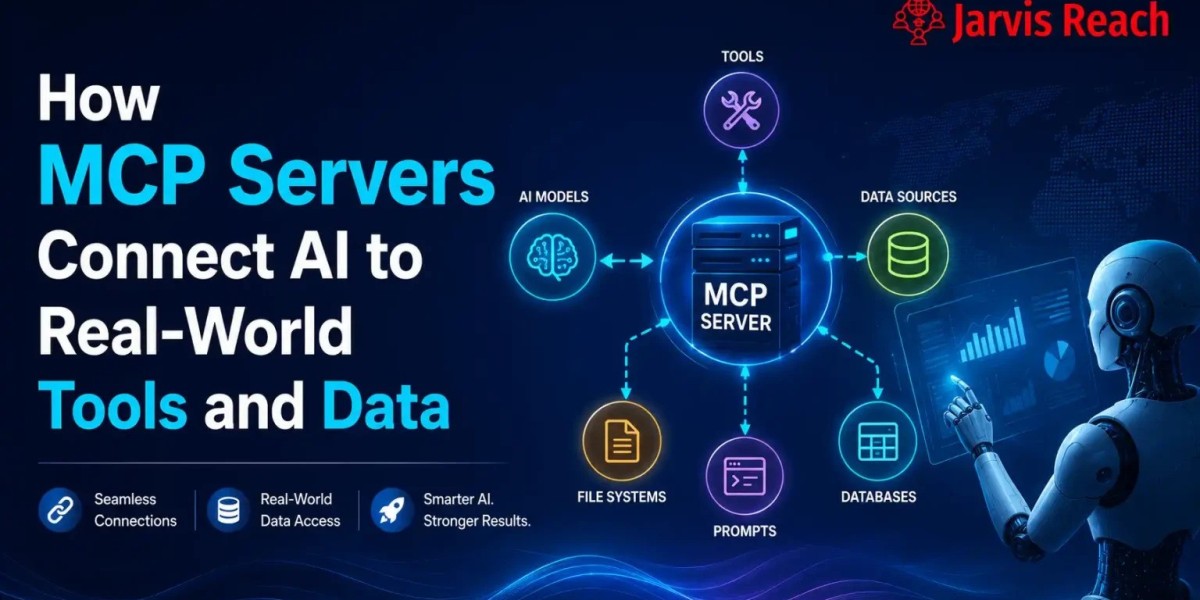

Artificial intelligence is no longer limited to answering questions or generating text. Modern AI applications need secure access to business tools, databases, and live information to deliver accurate results. An MCP Server makes this possible by creating a standardized communication layer between AI models and external systems. Whether you're building an AI assistant or an enterprise automation platform, MCP Server simplifies integration while improving security and scalability.
What Is an MCP Server?
An MCP Server is the server-side implementation of the Model Context Protocol (MCP). It allows AI applications to communicate with external resources using a single, standardized protocol instead of building separate integrations for every service.
With an MCP Server, developers can connect AI models to APIs, SQL databases, enterprise data, file systems, and other business applications without increasing development complexity.
How the MCP Client Communicates
Every MCP environment includes an MCP Client that works alongside the server. The client sends requests from the AI application, while the MCP Server retrieves the required information from connected backends and returns structured responses.
This architecture creates a clean separation between AI models and external services, making applications easier to maintain and expand.
Seamless API Connectivity
Most AI applications rely on external services to perform tasks. Through secure API integration, MCP Servers enable AI assistants to retrieve live information, automate workflows, and interact with third-party software.
Instead of writing custom connectors for every service, developers only need one standardized integration layer.
Secure Access to Enterprise Data
Organizations store valuable information across CRMs, ERPs, cloud platforms, and internal applications. MCP Servers simplify access to enterprise data, allowing AI systems to retrieve relevant business information while maintaining strict security controls.
This makes AI assistants more useful for customer support, reporting, and internal knowledge management.
Connecting SQL Databases
Business decisions often depend on structured information stored in SQL databases. MCP Servers enable AI applications to query databases directly, retrieve records, generate summaries, and provide data-driven responses without manual intervention.
This capability improves productivity while reducing the time spent searching for information.
Working with Multiple Data Sources
Modern businesses rely on many different data sources, including cloud storage, SaaS platforms, spreadsheets, and internal systems. MCP Servers unify access to these resources, giving AI applications a complete view of organizational information.
The result is more accurate and context-aware responses.
File Systems Integration
An MCP Server can also connect directly to file systems, allowing AI models to search documents, read reports, analyze PDFs, and retrieve stored knowledge whenever users request information.
This integration is especially valuable for organizations managing large document repositories.
Prompt Templates Improve AI Performance
Reusable prompt templates help maintain consistency across AI interactions. Organizations can standardize instructions, reduce repetitive prompt engineering, and improve the quality of AI-generated responses.
Prompt templates also simplify deployment across multiple departments and applications.
Authentication Protects Sensitive Resources
Security is essential when AI interacts with business systems. MCP Servers implement robust authentication mechanisms that verify users before granting access to connected resources.
This helps organizations protect confidential information while allowing AI applications to work securely with enterprise systems.
Stateless vs Stateful MCP Servers
An MCP Server can operate in two different ways depending on application requirements.
A stateless server processes every request independently. Since no session information is stored, it offers excellent scalability and performance.
A stateful server retains context between requests, making it ideal for conversational AI, customer service platforms, and long-running workflows that require memory.
Why AI Platforms Need MCP Server
Every modern AI platform depends on reliable access to external systems. MCP Server provides the standardized infrastructure needed to connect AI models with APIs, enterprise data, SQL databases, file systems, and other backends securely.
By reducing integration complexity, organizations can focus on developing smarter AI experiences instead of managing multiple custom connectors.
Key Benefits of MCP Server
- Standardized communication between AI models and external services
- Fast integration with APIs and enterprise applications
- Secure authentication and access management
- Direct connectivity to SQL databases and file systems
- Unified access to multiple data sources
- Reusable prompt templates for consistent AI responses
- Flexible stateless and stateful deployment models
- Scalable architecture for enterprise AI platforms
Conclusion
An MCP Server is becoming an essential building block for modern AI development. It enables secure communication between MCP Clients and external backends while providing access to APIs, enterprise data, SQL databases, file systems, and other critical resources. As businesses continue investing in intelligent automation, adopting MCP Server technology will simplify integration, improve security, and create scalable AI solutions capable of supporting future innovation.