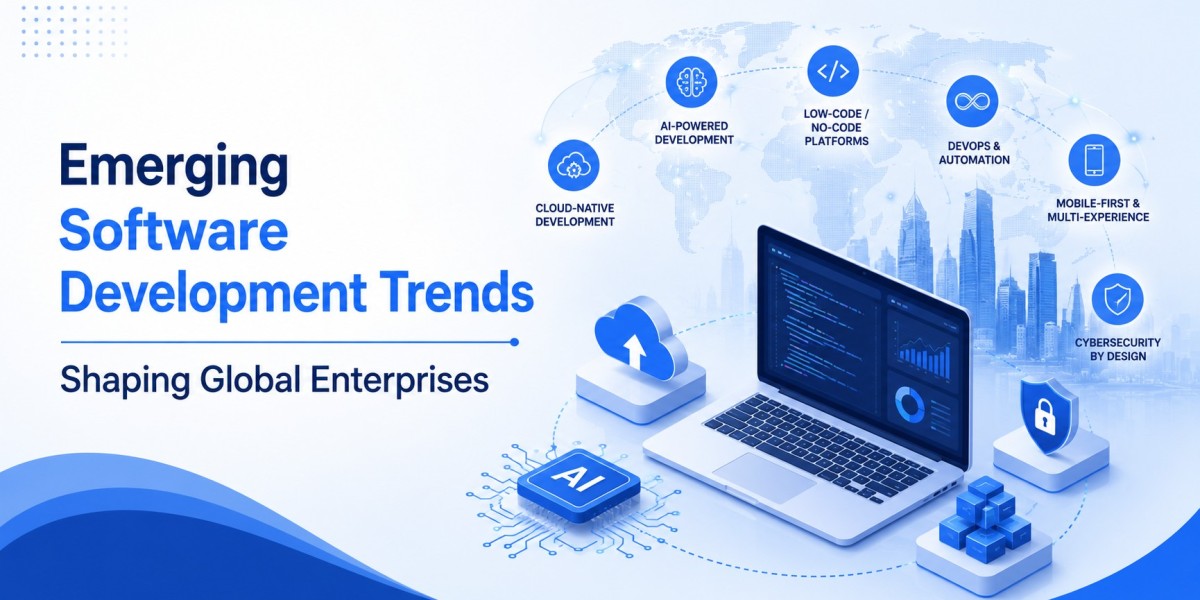

Enterprise software has gone through more structural change in the last three years than in the previous decade combined. The trends reshaping how global businesses build, deploy, and maintain software aren't incremental tweaks to existing practices — they represent a genuine shift in what's technically possible and what business owners should expect from their technology investments. Staying current with these shifts isn't optional for organizations that want their software to remain a competitive asset rather than a depreciating liability. The businesses moving fastest on these trends are typically working with a capable custom software development company that can translate emerging patterns into practical implementation, rather than trying to absorb every new development trend through internal research alone.
What makes this moment particularly consequential is the compounding effect of several trends arriving simultaneously. AI integration, cloud-native architecture maturity, and the shift toward composable enterprise systems are reinforcing each other in ways that create genuinely new possibilities — possibilities that simply didn't exist when most enterprise software was originally architected. Business owners evaluating their technology roadmap need a clear-eyed view of which trends represent durable shifts worth investing in now, and which are still maturing enough to warrant a more cautious wait-and-see approach.
AI Is Now an Architectural Layer, Not a Feature
The most consequential shift in enterprise software development is the move from AI as an add-on feature to AI as a foundational architectural layer that shapes how entire systems are designed. Two years ago, businesses were adding chatbots and recommendation widgets to otherwise conventional applications. Today, the leading enterprise software being built incorporates AI into the core data flow — intelligent routing decisions, automated quality checks, predictive resource allocation — woven into the system's fundamental logic rather than bolted on as a separate module.
This shift has significant implications for how businesses should approach their next software investment. Architectures that treat AI as an afterthought tend to require expensive rework when the business eventually wants AI capabilities embedded more deeply, while architectures designed with AI integration in mind from the start can incorporate increasingly sophisticated intelligence without structural rebuilds. Enterprises working with custom software development services that understand this architectural distinction are building systems that will remain extensible as AI capability continues to advance, rather than systems that will need replacement within a few years.
How AI-first architecture is reshaping enterprise development priorities:
- Data pipeline design as a first-class concern — systems built with the data quality and structure that AI models actually need, rather than retrofitting AI onto data architectures designed for other purposes
- Embedded inference layers — applications architected to call model inference as a routine part of business logic, not as an external integration bolted onto existing workflows
- Feedback loop infrastructure — systems designed to capture the data needed for continuous model improvement as a built-in capability, not an afterthought
- Human-in-the-loop design patterns — interfaces that gracefully blend automated AI decisions with human review and override, a pattern increasingly expected in enterprise contexts
Composable and Microservices Architecture Replacing Monoliths
Large monolithic applications, once the default architecture for enterprise systems, are steadily giving way to composable architectures built from modular, independently deployable services. This shift isn't new in concept, but the maturity of supporting tooling — container orchestration, service mesh technology, API gateway management — has reached the point where composable architecture is now the practical default for new enterprise builds rather than an advanced pattern reserved for the most sophisticated technology organizations.
The business case driving this trend is straightforward: monolithic systems become progressively harder to modify safely as they grow, turning every new feature into a risk-laden change to a tightly coupled system. Composable architectures let different teams work on different services independently, let businesses replace or upgrade individual components without touching the entire system, and let organizations scale the specific parts of their application experiencing the most demand rather than scaling everything uniformly. For growing enterprises, this translates directly into faster feature delivery and lower risk associated with each individual deployment.
Why composable architecture has become the dominant enterprise pattern:
- Independent service scaling — resource allocation matched precisely to which services actually need it, rather than uniform scaling across an entire monolithic application
- Faster, lower-risk deployments — changes to individual services can ship without requiring full-system regression testing and coordinated release cycles
- Technology flexibility per service — different services can use the technology stack best suited to their specific function rather than forcing uniformity across the entire system
- Easier AI and third-party integration — modular architectures make it considerably simpler to add or swap AI capabilities, payment providers, or other third-party services without systemic disruption
The Maturing Role of Low-Code and Pro-Code Working Together
Low-code and no-code platforms have moved well past their early reputation as tools only suitable for simple internal applications. The current generation of low-code platforms genuinely accelerates legitimate enterprise development for specific categories of applications — internal tools, workflow automation, and rapid prototyping — while professional custom development remains the right approach for core products, complex integrations, and anything requiring genuine architectural sophistication or competitive differentiation. The trend isn't low-code replacing custom development; it's the two approaches finding their appropriate place within a coordinated enterprise technology strategy.
Smart enterprises are beginning to use low-code platforms strategically, freeing their professional development resources to focus on the systems that actually require deep technical expertise while routing simpler internal tooling needs through low-code platforms that business users can adapt without engineering involvement. The challenge for many organizations is establishing the judgment to know which category a given need falls into — and this is precisely the kind of strategic guidance that an experienced development partner can provide, having seen which low-code implementations succeed and which eventually require a costly migration to custom-built systems.
Where the line between low-code and custom development typically falls:
- Internal operational tools — workflow approvals, simple data collection forms, and internal dashboards are often well-served by low-code platforms
- Customer-facing differentiated products — anything that represents your core competitive offering generally requires custom development for the flexibility and performance it demands
- Complex integration requirements — systems requiring deep integration with multiple specialized backend systems typically outgrow low-code platform capabilities quickly
- Compliance-sensitive applications — regulated industry applications often need the architectural control that custom development provides for audit trails and data governance
Why Software Development Services in India Are Central to These Trends
Global enterprises adopting these emerging trends are increasingly sourcing the technical talent to implement them through software development services in India, and the reasons extend beyond the familiar cost argument. India's developer ecosystem has moved in lockstep with these architectural trends — Indian engineering teams have deep, current experience in cloud-native development, microservices architecture, and AI integration precisely because they've been building these systems for global clients throughout the period when these trends were maturing. That hands-on experience across diverse client environments produces practitioners who understand not just the theory behind these architectural shifts but the practical implementation challenges that only emerge once a system is in production. Enterprises sourcing comprehensive software development services from these teams gain access to that production-tested judgment from day one rather than paying for it through their own trial and error.
For enterprises evaluating where to source the expertise needed to modernize their technology stack, engaging a software development company in India with demonstrated experience in current architectural patterns provides access to talent that has already navigated the learning curve these trends require. This matters considerably given how quickly the underlying technology continues to evolve — a development team without recent hands-on experience in composable architecture or AI integration will face a steeper learning curve that translates directly into project risk and timeline uncertainty for the business funding the work.
What makes Indian development talent well-positioned for these emerging trends:
- Continuous exposure to evolving architecture patterns — sustained work across multiple global clients keeps practitioners current with the latest implementation approaches
- Full-stack capability across AI and traditional development — many Indian development firms have built genuine cross-disciplinary depth spanning AI development services and conventional software architecture
- Cost structure enabling experimentation — favorable economics make it more feasible for enterprises to pilot emerging architectural patterns before committing to a full-scale rollout
- Established remote delivery maturity — the operational infrastructure for distributed development has matured to the point where geography creates minimal friction for sophisticated technical work
Choosing the Right Partner to Navigate These Trends
Identifying the best software development company in India to help your enterprise adopt these emerging trends requires evaluating recent, specific project experience rather than relying on general claims of AI or cloud expertise that have become standard marketing language across the industry. The trends reshaping enterprise software are evolving quickly enough that a firm's experience from two or three years ago may already be outdated relative to current best practices, particularly in AI integration where the underlying tools and techniques have changed substantially even within the last twelve months.
The evaluation conversation should probe specifically: what composable architecture projects has the firm completed recently, how have they approached AI integration in production systems, and what's their experience helping clients navigate the low-code versus custom development decision. Custom software consulting services that begin with this kind of specific technical conversation — rather than a generic capabilities presentation — are signaling the kind of current, hands-on expertise that these fast-moving trends require.
Key questions to ask when evaluating a development partner for emerging trend adoption:
- Recent project specificity — can they describe actual implementations of composable architecture or AI integration completed within the last year, not older case studies?
- Architectural judgment — do they offer genuine trade-off analysis on monolith versus microservices decisions specific to your situation, or a one-size-fits-all recommendation?
- AI integration depth — can they speak specifically to data pipeline design, model serving infrastructure, and monitoring practices, not just high-level AI strategy?
- Low-code versus custom guidance — do they have a clear, defensible framework for which of your specific needs warrant custom development versus low-code platforms?
For enterprises ready to move from evaluation to execution, the option to hire dedicated developers who already carry hands-on experience in these emerging patterns removes much of the ramp-up time that a less current team would require.