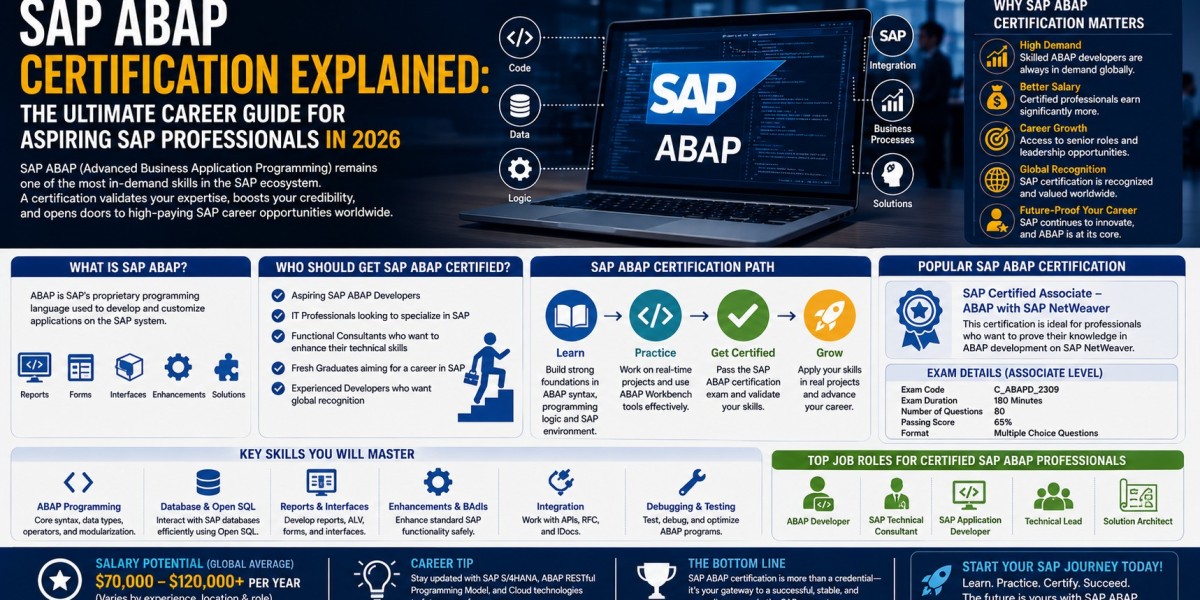

The world of enterprise technology is constantly evolving, but SAP programming continues to play an important role in helping organizations manage complex business operations. From finance and supply chain management to human resources and sales, businesses rely on SAP solutions to connect processes, automate tasks, and make better decisions.
Behind many of these customized SAP solutions is SAP ABAP, a programming environment designed for developing applications and extending SAP systems. For aspiring developers, learning ABAP can open the door to specialized career opportunities in enterprise software development.
If you are considering SAP ABAP certification in 2026, this guide explains what ABAP is, why it matters, what you can learn through training, and how it can support your long-term career goals.
What Is SAP ABAP?
SAP ABAP stands for Advanced Business Application Programming. It is the programming language traditionally associated with SAP application development and is widely used to customize, extend, and develop functionality within SAP environments.
ABAP was created specifically to support business applications. Unlike programming languages primarily used for consumer applications or websites, ABAP focuses heavily on business processes, data management, reporting, transactions, and integration within SAP systems.
Developers use ABAP to create programs that can process business data, generate reports, automate repetitive activities, develop interfaces, and customize standard SAP functionality. For someone entering enterprise technology, learning ABAP means gaining both programming knowledge and an understanding of how businesses use ERP systems.
Why Is SAP ABAP Still Relevant in 2026?
One common question among beginners is whether learning ABAP is still worthwhile when organizations are adopting cloud platforms, artificial intelligence, and automation.
The answer is that SAP's technology landscape continues to evolve, and ABAP remains relevant within modern SAP development environments. Organizations still need professionals who understand how to work with SAP applications, business data, custom developments, integrations, and extensions.
Modern SAP development is also moving beyond traditional approaches. Developers increasingly need to understand newer development concepts alongside established ABAP skills.
This makes learning ABAP particularly valuable for professionals who want to combine traditional SAP development expertise with modern enterprise technology skills.
Understanding the SAP Program Environment
An SAP program is essentially a piece of code designed to perform a specific task within an SAP environment. Programs can be used for reporting, data processing, automation, calculations, integrations, and other business requirements.
For example, a company may need a customized report showing sales information based on specific internal requirements. An ABAP developer can create a program that retrieves relevant information from SAP databases, processes it, and presents the results in a useful format.
This business-oriented approach is one reason SAP development differs from general-purpose programming. The developer needs to understand not only how to write code but also why the business needs the application.
What Is SAP ERP Programming?
SAP ERP programming involves developing and customizing applications that operate within an SAP Enterprise Resource Planning environment. ERP systems bring different business functions together. A single SAP environment may contain information related to finance, procurement, sales, inventory, production, and human resources.
ABAP developers can create custom functionality around these processes. Their work may involve:
Developing custom reports
Creating business forms
Automating repetitive processes
Working with SAP database tables
Developing interfaces
Enhancing existing SAP functionality
Troubleshooting application issues
Processing and validating business data
Therefore, SAP ERP programming is not simply about writing lines of code. It involves understanding business requirements, SAP architecture, data structures, and application behavior.
SAP Programming Language ABAP: What Should Beginners Learn?
If you are completely new to SAP programming language ABAP, you may wonder where to begin.
A structured learning path can make the process much easier. Beginners should first understand fundamental programming concepts before moving into more advanced SAP development topics. Important areas include:
ABAP Syntax
Learning ABAP syntax gives you the foundation for writing executable programs. You should become comfortable with variables, statements, operators, conditions, and basic program structures.
Data Types and Variables
ABAP applications work extensively with business information. Understanding data types, variables, structures, and internal data representation is therefore essential.
Internal Tables
Internal tables are a major part of ABAP programming language development. They allow developers to work with collections of data inside programs.
Database Access
ABAP developers frequently retrieve and manipulate business information stored within SAP databases. Learning database access concepts is therefore an important part of SAP programming.
Modularization
Large applications are easier to maintain when functionality is divided into logical components. ABAP provides different approaches for organizing reusable programming logic.
Reports and Output
Developers should understand how to create programs that retrieve, process, and display business information in useful formats.
What Is SAP ABAP Programming Used For?
ABAP SAP programming has many practical applications within enterprise environments. A developer may be asked to create a custom report that combines information from several sources. Another project might require a business process to be automated to reduce manual work.
ABAP can also be used for developing custom forms, interfaces, enhancements, and other application components. Some common use cases include:
Business reporting: Organizations often require reports that are more specific than standard SAP reports.
Data processing: ABAP programs can process large amounts of business information according to defined rules.
Automation: Repetitive activities can potentially be automated through customized SAP applications.
System integration: SAP systems frequently need to exchange information with external applications.
Application enhancement: Developers can extend existing SAP functionality to address specific organizational requirements.
This variety gives ABAP professionals opportunities to work on different types of enterprise technology projects.
Why Consider SAP ABAP Certification?
An SAP ABAP certification can demonstrate that you have developed knowledge in a specialized SAP development area. For beginners, certification can also provide a structured learning objective. However, certification should not be viewed as a replacement for practical experience. A strong ABAP professional typically combines:
Programming fundamentals
SAP knowledge
Business-process understanding
Database concepts
Problem-solving skills
Practical development experience
Continuous learning
Certification can help validate knowledge, while projects and hands-on practice help you develop the ability to apply that knowledge. For job seekers, having a recognized certification alongside practical skills may also help strengthen a professional profile.
SAP ABAP Training: What Can You Expect to Learn?
Quality SAP ABAP training should move beyond simply explaining syntax. It should help learners understand how ABAP fits into real SAP development. A training program may introduce learners to topics such as:
ABAP development fundamentals
SAP development environments
Data types and variables
Internal tables
Database concepts
Program structures
Reports
Modular programming
Debugging
Practical SAP development concepts
The exact curriculum varies between training providers, so learners should review the course structure before enrolling. For beginners, a course that starts with fundamentals and gradually introduces practical concepts can make learning significantly more manageable.
SAP Code: Why Clean Programming Matters
Writing SAP code is only one part of being a successful ABAP developer. Writing code that other developers can understand, maintain, and troubleshoot is equally important.
Enterprise applications may remain in use for years. A poorly structured program can become difficult to maintain as requirements change. Good ABAP development therefore involves paying attention to:
Clear naming conventions
Logical program structure
Reusable code
Appropriate comments
Efficient database access
Error handling
Maintainability
Performance
A developer who understands these principles can contribute more effectively to long-term SAP projects.
Skills You Need to Build an SAP Programming Career
Learning SAP programming requires more than memorizing commands. Employers and project teams typically value professionals who can analyze problems and develop practical solutions.
Programming Fundamentals
You should understand basic concepts such as variables, loops, conditions, functions, data structures, and debugging.
Database Knowledge
Because enterprise applications rely heavily on data, database concepts are highly valuable for ABAP developers.
Business Understanding
ABAP developers work closely with business processes. Understanding how sales, finance, procurement, inventory, or other processes operate can make you a more effective developer.
Problem-Solving
Development frequently involves identifying why something does not work and determining the most appropriate solution.
Communication
Developers may need to communicate with functional consultants, project managers, business users, and other technical teams.
Combining technical and communication skills can help you progress beyond entry-level development work.
Career Opportunities After SAP ABAP Training
Completing SAP ABAP training can provide a foundation for several career directions within SAP technology. Depending on experience and additional skills, professionals may pursue roles such as:
SAP ABAP Developer
SAP Technical Consultant
SAP Development Consultant
SAP Application Developer
SAP Technical Support Specialist
SAP Integration Developer
Career progression depends on practical experience, technical specialization, project exposure, and the ability to work with modern SAP technologies. Professionals can also expand their expertise by learning related areas such as SAP integration, databases, cloud technologies, application development, and enterprise architecture.
How to Start Learning ABAP in 2026
If you are starting from scratch, avoid trying to learn every SAP technology simultaneously. A better approach is to create a progressive learning path.
Step 1: Learn programming fundamentals.
Understand variables, conditions, loops, data structures, and basic programming logic.
Step 2: Learn ABAP fundamentals.
Become familiar with the syntax, development environment, and core concepts of the language.
Step 3: Practice database operations.
Learn how ABAP programs work with business data.
Step 4: Build small projects.
Create simple reports and programs rather than relying entirely on theoretical lessons.
Step 5: Learn debugging and optimization.
Understand how to identify errors and improve application performance.
Step 6: Explore modern SAP development.
Once your fundamentals are strong, explore newer SAP development approaches and related technologies.
Step 7: Consider certification.
After building sufficient knowledge, certification can provide an additional way to demonstrate your capabilities. This approach creates a stronger foundation than attempting to memorize isolated examples.
Why Practical Projects Matter
One of the biggest mistakes beginners make is focusing entirely on theoretical learning. You can read about internal tables, database queries, and program structures for weeks, but practical development gives you a completely different level of understanding. Try building small projects such as:
Employee information reports
Product inventory reports
Sales summaries
Customer data processing programs
Simple automated business workflows
The goal is not to create a massive enterprise application immediately. Instead, small projects allow you to understand how individual concepts work together. Over time, these projects can become part of a portfolio that demonstrates your practical skills.
SAP ABAP Certification vs. General Programming Skills
Another important consideration is the relationship between SAP-specific skills and general programming knowledge. Learning ABAP can give you specialized expertise, but general programming principles remain valuable. Concepts such as algorithms, data structures, debugging, version control, testing, and software design can help you become a better developer regardless of the technology you use.
For this reason, aspiring professionals should think of ABAP as part of a broader technical skill set. A developer who understands both SAP business environments and fundamental software development principles can be better positioned to adapt as enterprise technology changes.
How SAP ABAP Can Support Career Growth
The combination of SAP expertise and programming ability can create a specialized professional profile. Organizations implementing or maintaining SAP environments need professionals who can understand technical requirements and translate them into working solutions.
As you gain experience, you may move from basic development tasks toward more complex responsibilities involving system integration, architecture, performance, technical consulting, or project leadership. The key is continuous development. Instead of treating SAP ABAP certification as the final destination, consider it one milestone within a broader career journey.
Introduction to SAP ABAP Programming Training by GI Intelligence
If you are looking for a structured way to begin learning ABAP, GLOBAL INDUSTRIES INTELLIGENCE LTD offers an Introduction to SAP ABAP Programming Training designed to help learners develop foundational knowledge of SAP ABAP programming.
The course can be particularly useful for professionals and aspiring SAP developers who want to understand the fundamentals before progressing into more advanced SAP development concepts. A structured training environment can make it easier to learn programming concepts systematically while understanding their relevance to SAP systems.
For beginners, starting with a focused SAP ABAP training program can provide a clearer learning path than attempting to navigate the technology independently.
Frequently Asked Questions About SAP ABAP
Is SAP ABAP difficult to learn?
ABAP can be challenging for complete beginners, particularly if they have never programmed before. However, learning the fundamentals step by step and practicing regularly can make the process much easier.
Is SAP ABAP a programming language?
Yes. ABAP is a programming language developed for SAP application development and business-process customization.
Is SAP ABAP still useful in 2026?
Yes. ABAP remains an important skill within SAP development, although the SAP ecosystem continues to evolve and developers increasingly need awareness of modern development approaches.
Do I need programming experience before learning ABAP?
Not necessarily. Beginners can learn ABAP, although basic programming knowledge can make the learning process easier.
Does SAP ABAP certification guarantee a job?
No certification can guarantee employment. However, certification combined with practical skills, project experience, and relevant knowledge can strengthen a candidate's professional profile.
What is the difference between SAP and ABAP?
SAP refers broadly to the software and technology ecosystem developed by SAP, while ABAP is a programming language used for developing and extending SAP applications.
Final Thoughts
SAP ABAP remains a valuable specialization for professionals interested in enterprise software development in 2026. From creating reports and processing business data to customizing applications and supporting complex ERP environments, ABAP developers can play an important role in SAP projects.
For aspiring professionals, the best starting point is to build strong programming fundamentals, understand the principles of SAP ERP programming, practice writing SAP code, and gradually develop practical experience. SAP ABAP training can provide structure, while certification can help validate your knowledge once you are prepared.
Ultimately, a successful career in ABAP is not built around a certificate alone. It comes from combining technical knowledge, practical development, business understanding, problem-solving, and continuous learning. If you are ready to enter the world of SAP programming, developing strong ABAP skills can be a meaningful step toward a specialized career in enterprise technology.