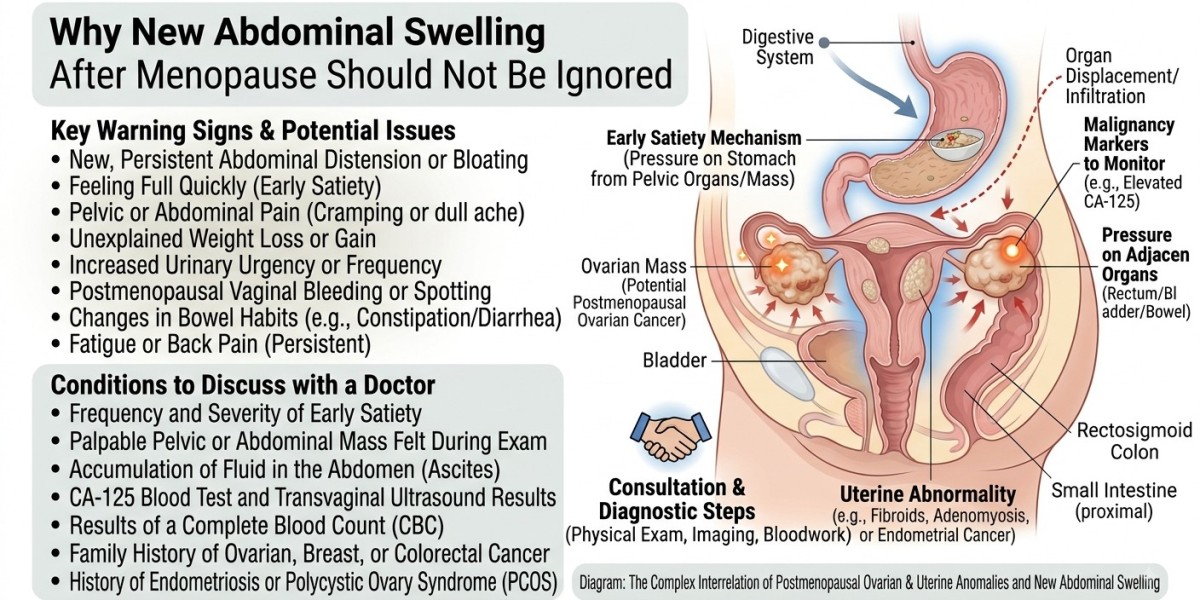

As we navigate the landscape of women’s health, we often find that the physiological changes of aging are either heavily stigmatized or dangerously dismissed. For many women, menopause represents a period of liberation, the end of monthly cycles, the cessation of contraceptive concerns, and a transition into a new phase of life.
However, from a clinical perspective, this transition also signals a shift in the baseline risk for certain pathologies. One of the most significant warning signs we, as educators and guides in the medical field, want to emphasize is the onset of new abdominal swelling.
It is not uncommon for postmenopausal women to attribute a growing waistline to weight gain, loss of muscle tone, or changes in metabolism. While these are valid factors, we must approach "new" swelling with a heightened degree of clinical suspicion. Here is why ignoring it is not an option.
The Menopausal Shift: Understanding the "New" Symptom
Before we get into the pathology, it’s crucial to spell out the difference between “chronic” and “new,” because otherwise it gets messy fast.
In the reproductive years, women often feel weight changes, and even a shift in abdominal girth, in step with menstrual cycles, more indulgent eating, or periods of stress. After menopause though, the hormonal setup changes, really quickly estrogen levels drop off a lot. As a result fat tends to migrate toward the belly area.
However, we must draw a line in the sand. New abdominal swelling meaning a noticeable, progressive increase in girth that occurs over weeks or months, rather than years is a clinical red flag. If your waistline is expanding while the rest of your body is stable, or if you notice a distinct "mass" feeling when you lie down, this is not simply "middle-age spread." This is a sign that warrants a pelvic examination and imaging.
The Ovarian Connection: A Silent Indicator
The most critical reason we stress this symptom is its connection to ovarian pathology. The ovaries sit deep within the pelvic cavity. In premenopausal women, these organs are dynamic and cyclic. In postmenopausal women, they are dormant and fibrotic.
When a mass develops in a postmenopausal ovary, it pushes the intestines and pelvic organs upward, leading to the "bloating" or "swelling" sensation. This is why ovarian malignancies are often referred to as the "silent killer" they do not cause pain until they are advanced. The swelling is the body’s physical manifestation of space being occupied by something that does not belong.
Ascites (the accumulation of fluid in the abdominal cavity) is also a common culprit here. This fluid build-up is a direct result of tumor irritation or lymphatic blockage. If you notice that your abdomen feels "heavy" or that your waistband is getting tighter despite no dietary changes, this must be assessed.
Gastrointestinal Mimics: The Digestive Distress
While we must remain vigilant about gynecological origins, we also guide patients to consider the gastrointestinal tract. Menopause alters the gastrointestinal microbiome and slows gastric motility.
However, swelling accompanied by changes in bowel habits, specifically constipation that does not respond to fiber or laxatives, or a feeling of incomplete evacuation can indicate a mass impinging on the colon. Similarly, a new onset of acid reflux or an inability to eat a full meal because you feel "full" quickly (early satiety) is a sign that the abdominal pressure is affecting the stomach's capacity.
Uterine Concerns: The Endometrial Factor
Even though menopause has ceased menstruation, the endometrium can still cause trouble. Postmenopausal bleeding is the classic sign, but we must note that a distended abdomen can also result from a large uterine mass.
Fibroids, while common, usually shrink after menopause due to estrogen withdrawal. If a fibroid grows, or if a new mass develops, it can cause pressure. Furthermore, sarcoma (a rare but aggressive uterine cancer) can present as a rapidly enlarging uterus. If your belly is swelling and you feel a firm, irregular mass in the lower pelvis, this is a distinct deviation from the norm.
The Clinical Approach: What to Expect
If you are experiencing this symptom, we encourage you to approach it with a plan. There is no need for panic, but there is a necessity for action.
The Physical Exam: A bimanual pelvic exam is essential. We often say that a visual inspection of the abdomen is not enough; the physical palpation of the pelvic organs is the first line of defense.
Transvaginal Ultrasound: This is the gold standard. We look at the ovaries specifically. A "simple cyst" in a postmenopausal woman is not the same as a "simple cyst" in a 30-year-old. In the postmenopausal cohort, even simple cysts require surveillance. We specifically look for complex masses with solid components or blood flow.
Tumor Markers: Blood tests such as CA-125 (though not a diagnostic tool on its own) can provide a baseline. We advise that this marker is best used in conjunction with imaging to paint a full picture.
Finding the Right Guide
In a city like Delhi, where medical options are plenty, the quality of your diagnosis really depends on the know-how of the specialist you end up consulting. It’s not quite enough just to handle the acid reflux, you have to go after the root cause. This is exactly where the role of an expert becomes quite pivotal, because without that extra layer of understanding treatment can end up being superficial.
When seeking consultation, you want a practitioner who understands the nuances of postmenopausal physiology. A Gynecologist in South Delhi will often be the first point of contact for these concerns, but we stress that the specific experience of the clinician matters profoundly.
It is not just about having a clinic; it is about having a diagnostic mindset. The Best Gynecologist in South Delhi is not defined by the modernity of the clinic alone, but by the ability to recognize patterns. They will distinguish between "gas" and "ascites." They will know that a 5cm ovary in a postmenopausal woman needs investigation, whereas in a younger woman it might be normal. They will ensure that a CT scan or MRI is ordered if the ultrasound is inconclusive.
A Final Word on Timeliness
In the narrative of medicine, timing is everything. Women are often conditioned to endure discomfort. We are here to tell you that this is one symptom that should break that conditioning.
If you are postmenopausal and experience abdominal swelling especially if it is accompanied by fatigue, unexplained weight loss, or pelvic pressure do not wait for your annual check-up. Do not wait for it to "go away." This is not a lifestyle issue; it is a medical issue.
The swelling is your body’s signal. It is the physical manifestation of a change in your internal architecture. As education consultants, our role is to ensure you understand that early detection remains the single most effective tool in managing serious pathology.