
Search has changed more in the last two years than in the previous decade combined. Chatbots answer questions directly, AI Overviews sit above the organic results, and buyers increasingly ask ChatGPT or Perplexity for recommendations before they ever open Google. For any brand trying to stay visible, understanding AI Search SEO is no longer optional. It is the difference between showing up in the answer and disappearing from the conversation entirely.
This shift is not a passing trend. It is a rebuild of how discovery works online, and 2026 is the year most businesses will either adapt their strategy or start losing ground to competitors who already have.
Search Engine Basics Are Being Rewritten
For years, Search Engine Basics meant targeting keywords, building backlinks, and optimizing title tags so a page could climb ten blue links. That foundation still matters, but it is no longer the whole picture. Search engines now parse content, extract facts, and hand those facts to a language model that writes a summary before a user ever clicks through.
That means crawlability, structured data, and clean technical architecture remain essential, but they are now the entry ticket rather than the finish line. A page can be technically flawless and still get ignored by an AI system if it lacks clear entities, verifiable facts, and a trustworthy source profile.
What Is AI Search SEO and Why It Matters in 2026
AI Search SEO is the practice of optimizing content so it gets surfaced, cited, or summarized by AI-driven search systems such as Google AI Mode, ChatGPT, Perplexity, Gemini, and Copilot. Traditional ranking factors still apply, but AI Search SEO adds a new layer: making content easy for a language model to extract, trust, and quote.
Roughly half of Google searches now end without a click, and a growing share of queries are answered inside an AI summary rather than a list of links. Businesses that ignore this shift are optimizing for a search experience that is quietly shrinking. Businesses that adapt are positioning themselves to be the source an AI system actually chooses to cite.
Trend 1: Answer Engine Optimization Becomes Standard Practice
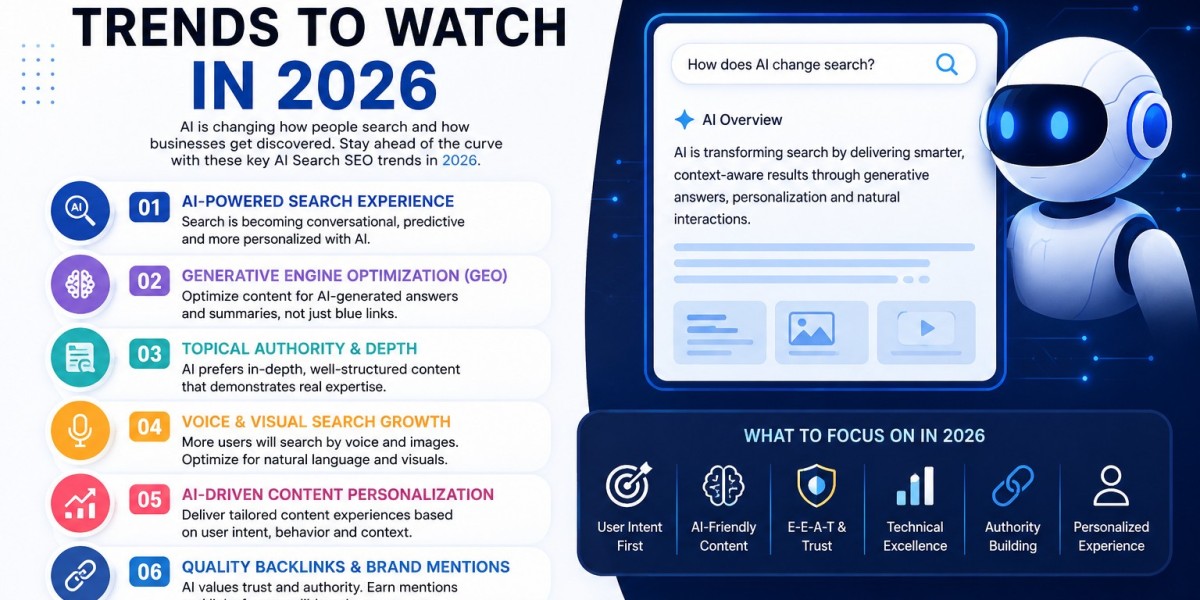
Answer Engine Optimization, often paired with Generative Engine Optimization, is becoming as fundamental as on-page SEO once was. Content structured around direct questions, concise definitions, and scannable subheadings performs better in AI-generated answers than long, meandering articles. Marketers are learning to write the answer first, then support it with depth, because that is the format language models pull from most easily.
Trend 2: Entity-First Content and Structured Data
AI systems do not rank pages in isolation anymore. They connect signals across an entire website, and sometimes across an entire brand, before deciding whether to trust it. This is entity-based SEO: building a site as an interlinked hub of authority rather than a collection of standalone pages. Schema markup, consistent NAP data, FAQ structuring, and clear author information all help an AI system confirm that a brand is a real, coherent entity worth citing.
This is exactly where SEO for AI search engines work differs from classic SEO. It is less about a single optimized page and more about proving, across dozens of connected pages, that your brand is a consistent and credible source. Sites that invest in this kind of entity architecture tend to see their content pulled into AI summaries far more consistently than sites relying on isolated, disconnected pages.
Trend 3: Multimodal and Conversational Search Expand the Playing Field
Search is no longer purely text-based. Voice assistants, visual search, and conversational follow-up questions are becoming standard ways people find information. Video transcripts, descriptive alt text, and content written in a natural, conversational tone all improve visibility across these formats. Brands that only optimize for typed keyword queries are missing a growing share of how people actually search in 2026.
Trend 4: Trust Signals Matter More Than Ever
Google's Search Quality Evaluator Guidelines have long emphasized Experience, Expertise, Authoritativeness, and Trust, commonly known as E-E-A-T, especially for Your Money or Your Life topics where inaccurate information could cause real harm. AI systems apply a similar filter before deciding what to cite. Author bylines, transparent sourcing, original data, and demonstrated first-hand experience all signal that content is safe to summarize and repeat to a user.
This is a core part of any serious SEO for AI search strategy. Thin, generic content built purely for keyword coverage is increasingly filtered out, while well-sourced, experience-backed content gets pulled into AI answers ahead of it.
Trend 5: Citations Become the New Ranking Metric
Instead of only tracking keyword rankings, marketers in 2026 are tracking how often their brand gets cited inside AI-generated answers. This is a fundamentally different metric. A page can drive real business value by being quoted inside a ChatGPT response even if it never appears on page one of traditional search results. Monitoring brand mentions across AI platforms, not just SERP position, is becoming a standard part of monthly reporting.
Building a Practical AI Search SEO Strategy
Businesses that want to stay visible through this shift generally focus on a few consistent moves:
Structuring content around clear questions and direct answers
Applying schema markup across articles, FAQs, and service pages
Building topical hubs instead of isolated blog posts
Publishing original data, case studies, and first-hand insights
Keeping author and brand information consistent and verifiable across the web
None of this replaces the fundamentals. It builds on them. A technically sound site with strong Search Engine Basics still forms the base layer that AI systems crawl and evaluate before anything else happens.
Why Businesses Are Turning to a Specialized SEO AI Agency
Because this shift touches technical SEO, content strategy, structured data, and brand reputation all at once, many businesses are choosing to work with a dedicated SEO AI agency rather than trying to manage the transition internally. The learning curve is steep, the platforms are evolving monthly, and the cost of falling behind is a slow, quiet loss of visibility that is hard to reverse later.
An experienced partner can audit how a brand currently appears across AI platforms, close the gaps in entity signals and structured data, and build a content roadmap designed for both traditional rankings and AI citations at the same time. This combination of technical SEO for AI search engines and ongoing content strategy is usually what separates brands that gain visibility from brands that quietly fall behind.
Final Thoughts
AI search is not replacing traditional SEO, it is expanding what SEO has to account for. The brands that treat AI Search SEO as a natural extension of solid technical and content fundamentals, rather than a separate discipline, will be the ones AI systems trust enough to cite in 2026 and beyond.
If your business needs a clear roadmap for showing up across Google, ChatGPT, and every other place your customers now search, the team at SEO Discovery can build a strategy tailored to your industry and your current search visibility.
Search is changing fast, but the brands that adapt early are the ones that end up owning the answer.