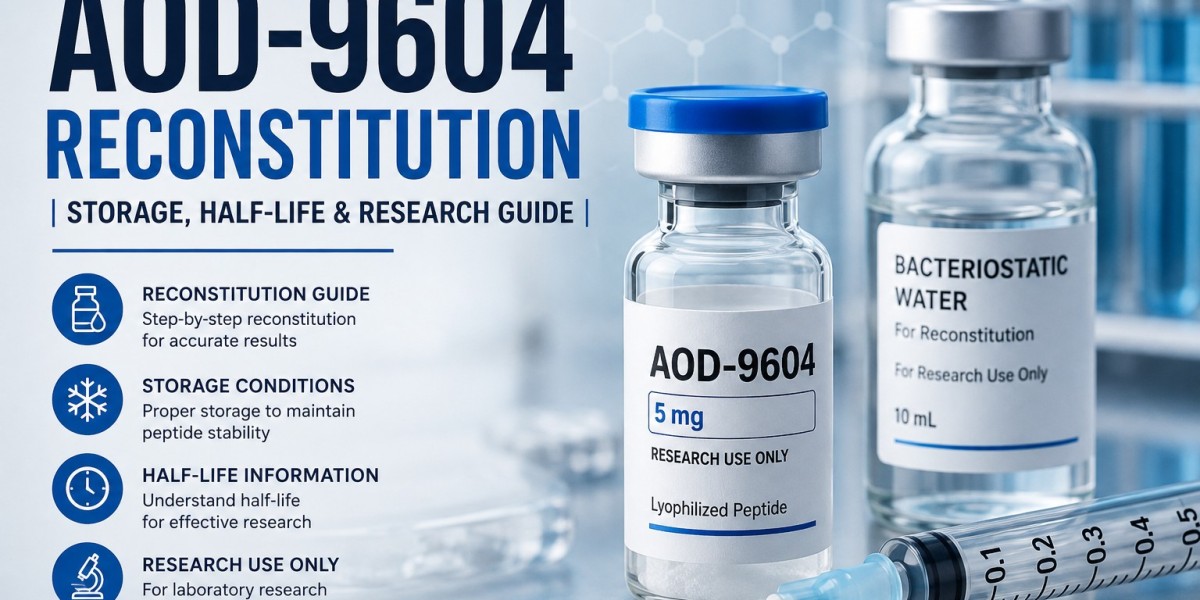

AOD-9604 can present some unique solubility challenges during laboratory preparation. Unlike peptides that readily dissolve in common aqueous solutions, AOD-9604 may require careful consideration of the solvent, pH, concentration, and preparation conditions to achieve a clear solution. This is why researchers sometimes encounter cloudiness, incomplete dissolution, or changes in appearance when working with the peptide.
This guide explains the key principles behind AOD-9604 peptide reconstitution, including why acidic conditions such as acetic acid may be discussed for this particular peptide. It also covers important questions surrounding refrigeration, storage, stability, and AOD-9604 half-life. Written for U.S.-based laboratory researchers, the guide focuses on research handling, product documentation, and following validated manufacturer or laboratory protocols.
AOD-9604 Reconstitution: The Standard Starting Point
Standard AOD-9604 reconstitution begins the same way most lyophilized research peptides do. Using a sterile syringe, draw the calculated volume of your chosen solvent and inject it through the vial's septum, directing the stream gently against the glass wall rather than straight onto the freeze-dried powder this technique minimizes foaming and mechanical disruption of the peptide. After adding the solvent, avoid shaking the vial; instead,gently swirl it or place it on a slow tube rotator for five to fifteen minutes. A properly prepared, high-purity lyophilized sample should dissolve into a clear, colorless solution with gentle agitation.
AOD Peptide Reconstitution: Choosing the Right Solvent
Broadly speaking, AOD peptide reconstitution can be approached with a few different solvent options depending on your specific research needs. Bacteriostatic water is suitable for straightforward reconstitution and short-term storage, offering antimicrobial preservation through its benzyl alcohol content, though this can introduce a confounding variable in sensitive cell-based assays. For routine research purposes, bacteriostatic water generally strikes a solid balance between sterility, stability, and compatibility, and remains the default choice most researchers reach for first.
AOD 9604 Acetic Acid Reconstitution: Why This Peptide Specifically Needs It
Here's where AOD-9604 diverges from a lot of other research peptides. AOD 9604 acetic acid reconstitution exists as an option specifically because of the compound's solubility profile —a dilute acetic acid solution, typically 0.1-1% glacial acetic acid in sterile water, is preferred when AOD-9604 doesn't dissolve readily in plain water at higher concentrations, since the mildly acidic environment improves dissolution kinetics for peptides with basic residues like AOD-9604's arginines. Acetic acid works by lowering the pH of the solution, which can improve peptide solubility, reduce aggregation, and help the peptide dissolve more completely when it would otherwise appear cloudy, form visible particles, or develop a gel-like consistency in neutral water alone.
AOD-9604 Reconstitution Acetic Acid: A Practical Walkthrough
For a practical approach to AOD-9604 reconstitution acetic acid, one commonly referenced method involves reconstituting with bacteriostatic water first and slowly adding acetic acid afterward if needed — adding it gradually rather than all at once, since introducing it too quickly can cause unwanted reactions in the solution. If the peptide still hasn't fully dissolved after your initial mixing attempt, allow an additional ten minutes of slow rotation, and if it remains undissolved, add a small additional volume of 0.1% acetic acid and continue mixing. That said, it's worth noting that some research guidance takes a more cautious stance here: AOD-9604 typically performs well in bacteriostatic water alone, and acid solutions might be too harsh for its structure or subsequent biological activity in standard research models, so acetic acid is generally best reserved for cases where standard water genuinely isn't dissolving the peptide, rather than used as a default first step.
There's also no single, universally standardized acetic acid protocol across the industry no strong source establishes acetic acid as a routine requirement for every AOD-9604 vial, and any specific mixing ratio should follow a verified laboratory method for the exact research material you're working with rather than a generic figure applied indiscriminately.
Does AOD 9604 Have to Be Refrigerated? Yes, and Here's Why
A question that comes up constantly: does AOD 9604 have to be refrigerated? In its unreconstituted, lyophilized form, the powder should be kept refrigerated and shielded from light to preserve its stability over time. Once reconstituted, refrigeration becomes even more critical research-supply guidance commonly calls for refrigerated storage between 2-8°C after reconstitution, protected from light, since the mixed solution is considerably more vulnerable to degradation than the dry powder it started as.