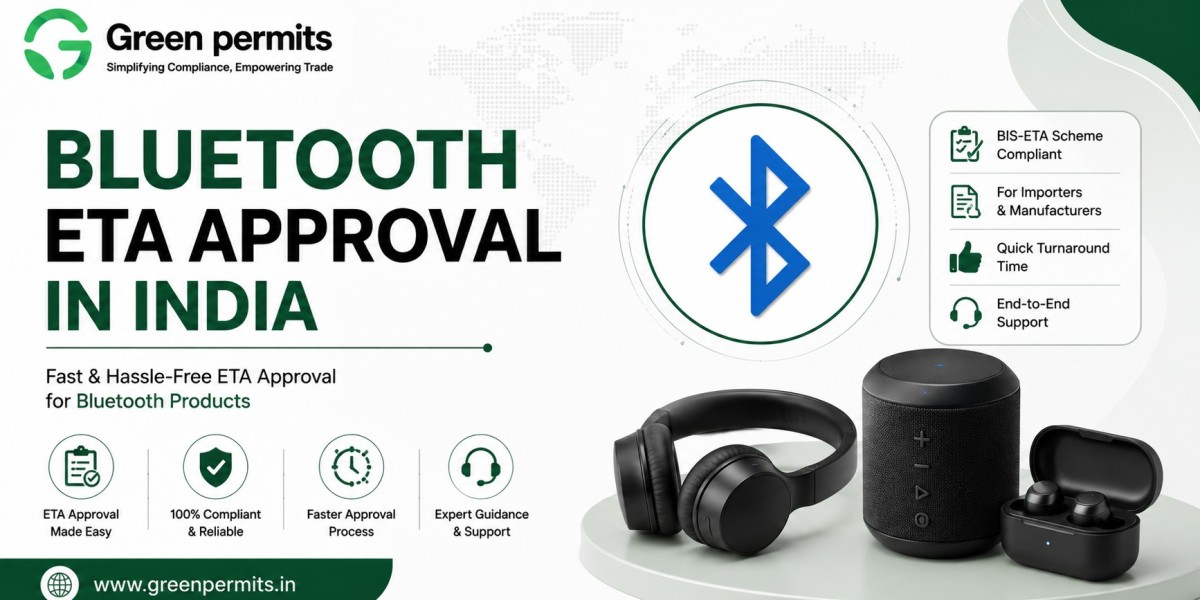

Bluetooth ETA Approval in India is an important regulatory requirement for manufacturers, importers, foreign brands, traders, distributors, and sellers dealing with Bluetooth-enabled wireless products. Many products used in daily life now come with Bluetooth connectivity, including speakers, headphones, earphones, smart watches, keyboards, mouse devices, fitness bands, smart home products, medical devices, automotive accessories, IoT devices, printers, scanners, cameras, and consumer electronics.
ETA stands for Equipment Type Approval. It is issued by the Wireless Planning and Coordination Wing, commonly known as WPC, under the Department of Telecommunications. WPC regulates radio frequency spectrum and wireless equipment use in India. Any device that uses Bluetooth or other radio frequency transmission in de-licensed frequency bands may need ETA approval before import, sale, distribution, or use in India.
Bluetooth devices may look simple from a consumer point of view, but they still transmit radio frequency signals. Therefore, importers and manufacturers must check WPC ETA applicability before bringing such products into the Indian market. Without proper ETA approval, businesses may face customs clearance issues, shipment hold, marketplace rejection, product delay, or regulatory compliance problems.
A Bluetooth ETA Approval Consultant helps businesses identify applicability, review RF test reports, check frequency band details, prepare documents, file the online application, upload undertakings, respond to queries, and obtain ETA approval for smooth import and sale in India.
What is Bluetooth ETA Approval?
Bluetooth ETA Approval is a certification issued for Bluetooth-enabled wireless devices that operate in de-licensed frequency bands permitted in India. It confirms that the equipment is operating within allowed frequency and technical parameters.
Bluetooth ETA Approval is generally required for products that:
- Use Bluetooth connectivity
- Transmit radio frequency signals
- Operate in de-licensed bands
- Are imported into India
- Are sold in the Indian market
- Are manufactured for commercial sale
- Are integrated with wireless modules
- Use RF communication for short-range connectivity
ETA approval is product and model-specific. If different models have different wireless specifications, frequency bands, or RF modules, separate review may be required.
Why Bluetooth ETA Approval is Important
Bluetooth ETA Approval is important because wireless devices must comply with India’s radio frequency regulations. Even if a product is already approved in another country, India-specific ETA compliance may still be required before import or sale.
Bluetooth ETA Approval helps businesses:
- Import Bluetooth products legally
- Avoid customs clearance delays
- Meet WPC and DoT requirements
- Sell wireless products in India
- Reduce shipment detention risk
- Improve marketplace listing readiness
- Build buyer and distributor confidence
- Avoid non-compliance issues
- Support product launch planning
- Maintain proper regulatory records
- Work smoothly with foreign manufacturers
- Reduce business uncertainty
For importers and brands, ETA approval should be completed before shipment planning, product launch, or large-scale sales.
Who Needs Bluetooth ETA Approval in India?
Bluetooth ETA Approval may be required by any business that imports, manufactures, distributes, or sells Bluetooth-enabled wireless products in India.
The following entities may need ETA support:
- Importers of Bluetooth products
- Foreign brands entering India
- Indian manufacturers of wireless products
- Consumer electronics companies
- Smart watch brands
- Bluetooth speaker importers
- Headphone and earphone sellers
- Mobile accessory importers
- IoT device companies
- Smart home product sellers
- Medical device importers using Bluetooth modules
- Automotive accessory importers
- E-commerce sellers
- Distributors and traders
- OEM and private label brands
- Businesses facing customs queries
The exact requirement depends on product type, wireless technology, frequency band, RF module, import route, and intended use.
Common Bluetooth Products That Need ETA Approval
Many Bluetooth-enabled products may need ETA approval before import or sale in India.
Common products include:
- Bluetooth speakers
- Bluetooth headphones
- Bluetooth earphones
- Wireless earbuds
- Smart watches
- Fitness bands
- Smart rings
- Wireless keyboards
- Wireless mouse devices
- Bluetooth printers
- Bluetooth scanners
- Bluetooth cameras
- Smart home devices
- IoT sensors
- Wireless controllers
- Bluetooth-enabled medical devices
- Bluetooth-enabled weighing scales
- Automotive Bluetooth accessories
- Wireless microphones
- Bluetooth audio receivers
- Bluetooth transmitters
- Bluetooth modules
- Consumer electronic gadgets with Bluetooth connectivity
If the device contains Bluetooth, Wi-Fi, Zigbee, RFID, or any other RF transmission feature, the complete wireless specification should be reviewed before import.
Role of WPC in Bluetooth ETA Approval
WPC stands for Wireless Planning and Coordination Wing. It functions under the Department of Telecommunications and is responsible for regulating radio frequency spectrum and wireless equipment in India.
For Bluetooth devices, WPC ETA approval helps ensure that the product operates within permitted de-licensed frequency bands and does not create unauthorized interference.
WPC-related compliance may include:
- Equipment Type Approval
- De-licensed frequency band verification
- RF test report review
- Wireless technical parameter review
- Import compliance support
- Self-declaration-based ETA filing
- ETA certificate issuance
Businesses should not assume that de-licensed band means no approval is needed. De-licensed use may still require ETA approval for equipment type.
Bluetooth ETA Approval Through Self-Declaration
For many finished wireless products operating in de-licensed bands, ETA may be obtained through self-declaration. This makes the process simpler than traditional wireless licensing, but documentation and technical accuracy are still very important.
Self-declaration-based ETA generally applies when:
- Product operates in permitted de-licensed bands
- Product is a finished commercial product
- Product does not require separate frequency assignment
- Product is not a restricted wireless category
- Product technical parameters match Indian requirements
- Required RF test report is available
- Applicant submits undertaking and documents
Products such as radar, jamming devices, drones, satellite equipment, or products using licensed frequency bands may require a different approval route.
Difference Between ETA Approval and Import Licence
ETA Approval and Import Licence are different approvals.
ETA Approval is related to equipment type approval for wireless products operating in permitted frequency bands.
Import Licence may be required for certain wireless equipment that does not fall under self-declaration ETA or operates in licensed frequency bands.
The basic difference is:
- ETA is for approved equipment type
- Import licence is for importing certain wireless equipment
- ETA applies to many de-licensed band wireless products
- Import licence may apply to restricted or licensed-band equipment
- ETA is commonly used for Bluetooth and Wi-Fi products
- Import licence may apply to more complex wireless equipment
For Bluetooth products, ETA through self-declaration is commonly applicable, but the final route should be checked product-wise.
Documents Required for Bluetooth ETA Approval
Proper documentation is essential for smooth ETA approval.
Common documents may include:
- Company Incorporation Certificate
- GST Registration Certificate
- PAN Card
- Import Export Code, for importers
- Authorized signatory details
- Product technical literature
- Product catalogue
- Product user manual
- RF test report
- Frequency band details
- Bluetooth version details
- Output power details
- Antenna details
- Model number details
- Brand details
- Product photographs, where required
- Authorization letter from manufacturer, where applicable
- Foreign manufacturer details, where applicable
- Self-declaration or undertaking
- Applicant contact details
- Fee payment details
Additional documents may be required depending on product type, applicant category, portal query, or technical review.
RF Test Report for Bluetooth ETA Approval
RF test report is one of the most important documents for Bluetooth ETA approval. It shows the technical parameters of the wireless function used in the product.
The RF test report may include:
- Product name
- Brand name
- Model number
- Frequency range
- Bluetooth technology details
- Output power
- Modulation details
- Antenna gain
- Test standard
- Test lab details
- Test date
- Technical results
The test report should match the product, model, brand, and wireless specifications proposed for ETA filing. If the report contains mismatched details, the application may face query or delay.
Bluetooth ETA Approval Process in India
The Bluetooth ETA Approval process should be handled step by step so that the product is correctly reviewed and approved.
Step 1: Product Applicability Check
The first step is checking whether the product requires ETA approval.
Applicability is assessed based on:
- Product type
- Bluetooth connectivity
- RF transmission feature
- Frequency band
- Wireless module details
- Import or manufacturing plan
- Finished product status
- Product use
- De-licensed band applicability
Correct applicability assessment helps avoid wrong filing and customs delays.
Step 2: Technical Specification Review
After applicability is confirmed, the technical specification of the product should be reviewed.
This includes checking:
- Bluetooth frequency band
- Output power
- Antenna gain
- Wireless module details
- RF test report
- Product model number
- Product brand name
- Other wireless technologies in the product
- Whether Wi-Fi or other RF bands are also present
If the product has Bluetooth plus Wi-Fi or other wireless functions, all applicable bands should be checked.
Step 3: Document Checklist Preparation
After technical review, the document checklist should be prepared.
Document preparation may include:
- Business documents
- Importer documents
- Manufacturer documents
- Product documents
- Technical literature
- RF test report
- Undertaking and declaration
- Authorization documents
- Fee payment documents
Complete documents reduce the chance of portal query or approval delay.
Step 4: Online Application Filing
The ETA application is generally filed online through the applicable DoT or WPC system.
The application generally includes:
- Applicant details
- Company details
- Product details
- Equipment category
- Brand and model details
- Frequency band details
- Technical parameters
- Document upload
- Fee payment
- Self-declaration submission
All details should match the product documents and RF test report.
Step 5: Upload Undertaking and Supporting Documents
The applicant may need to upload the required undertaking and supporting documents.
This may include:
- Self-declaration
- Product technical document
- RF test report
- Applicant authorization
- Importer documents
- Product model details
- Payment confirmation
The undertaking should be accurate because it confirms responsibility for the technical information submitted.
Step 6: Review and Query Response
The application may be reviewed for completeness and technical correctness.
Queries may relate to:
- Incorrect product category
- Missing RF test report
- Mismatch in model number
- Frequency band mismatch
- Missing technical literature
- Missing authorization document
- Incorrect applicant details
- Incomplete undertaking
- Fee payment issue
- Product not eligible for self-declaration
A proper query response helps move the application toward approval.
Step 7: Grant of ETA Certificate
After successful filing and review, ETA certificate is issued.
The business should check the certificate for:
- ETA number
- Product name
- Brand name
- Model number
- Equipment category
- Frequency band
- Applicant name
- Approval details
- Validity or conditions, where applicable
The ETA certificate should be kept ready for import, customs clearance, buyer records, and marketplace documentation.
Bluetooth ETA Approval for Importers
Importers must ensure that the exact Bluetooth product being imported is covered under ETA approval. Even small mismatches in brand, model, or wireless specification can create customs and compliance issues.
Importers should verify:
- ETA certificate number
- Product name
- Brand name
- Model number
- Foreign manufacturer details
- Frequency band
- RF test report consistency
- Invoice and packing list details
- Import Export Code details
- Product label and technical literature
This verification should be completed before shipment.
Bluetooth ETA Approval for Foreign Brands
Foreign brands selling Bluetooth products in India may need ETA approval through an Indian importer, authorized representative, or eligible applicant.
Foreign brand compliance may involve:
- Product technical document collection
- RF test report arrangement
- Brand and model verification
- Indian applicant coordination
- Authorization letter preparation
- ETA application filing
- Customs document support
- Distributor compliance support
Foreign brands should complete ETA before shipping products to Indian distributors or e-commerce sellers.
Cost of Bluetooth ETA Approval in India
The cost of Bluetooth ETA Approval depends on product category, documentation readiness, number of models, and consultant scope.
Major cost factors include:
- Number of products
- Number of models
- Number of brands
- Availability of RF test report
- Need for fresh testing
- Importer or manufacturer documentation
- Technical review requirement
- Query response requirement
- Government fee
- Consultant professional charges
If one product has multiple models or wireless configurations, the cost and documentation requirement may increase.
Timeline for Bluetooth ETA Approval
The timeline depends on document readiness, technical data availability, portal filing, payment, and query response.
The general timeline may include:
- Product applicability assessment: 1 to 2 working days
- Technical document review: 1 to 3 working days
- Document preparation: 2 to 5 working days
- Online application filing: 1 working day
- Fee payment and undertaking upload: 1 to 2 working days
- Review and query response: depends on query type
- ETA certificate download: after successful processing
Businesses should complete ETA approval before import shipment to avoid customs delays.
Common Mistakes During Bluetooth ETA Approval
Many businesses face delays because they treat ETA as a simple formality and do not review technical documents properly.
Common mistakes include:
- Importing Bluetooth devices before ETA approval
- Using wrong product category
- Uploading incomplete RF test report
- Mismatch in model number
- Mismatch in brand name
- Missing frequency band details
- Not checking all wireless technologies in the product
- Ignoring Wi-Fi or other RF functions
- Filing with incorrect applicant details
- Missing authorization letter
- Using outdated technical documents
- Not keeping ETA certificate ready for customs
- Assuming foreign approvals are enough for India
Professional guidance helps avoid these mistakes and improves approval efficiency.
Benefits of Hiring Bluetooth ETA Approval Consultant
Hiring a Bluetooth ETA Approval Consultant provides several practical benefits.
These include:
- Correct applicability check
- Technical specification review
- RF test report review
- Proper document checklist
- Faster application preparation
- Accurate online filing
- Stronger query response
- Support for importers and foreign brands
- Better customs readiness
- Reduced shipment delay risk
- Model-wise compliance support
- Ongoing wireless compliance advisory
A consultant helps businesses obtain ETA approval smoothly and reduce wireless regulatory risk.
Importance of Ongoing Wireless Compliance
Bluetooth ETA Approval is an important first step, but businesses should also maintain ongoing wireless compliance.
Ongoing compliance may include:
- Importing only approved models
- Keeping RF test reports ready
- Maintaining ETA certificate records
- Checking frequency changes
- Reviewing product design changes
- Checking new models before import
- Updating documents when product specifications change
- Coordinating with foreign manufacturers
- Maintaining customs documents
- Ensuring marketplace documentation readiness
If a product model, wireless module, frequency band, antenna, or RF specification changes, fresh review or new ETA may be required.
Learn More About Bluetooth ETA Approval in India
If your business imports, manufactures, distributes, or sells Bluetooth speakers, headphones, earphones, smart watches, keyboards, mouse devices, IoT products, smart home devices, cameras, scanners, printers, or other Bluetooth-enabled products in India, understanding ETA approval is essential before shipment or sale.
Read the complete guide here:
? https://www.greenpermits.in/08/wpc-eta-approval-in-india-for-bluetooth-and-wi-fi/
? Get Expert Assistance for Bluetooth ETA Approval
If you need help with Bluetooth ETA Approval in India or WPC compliance, Green Permits Consulting can assist you.
? Website: https://www.greenpermits.in/
? Phone: +91 78350 06182
? Email: wecare@greenpermits.in