
As of June 2026, the diagnostic landscape in Bangalore has undergone a significant transformation, driven by an urgent need for preventive cardiac care. Recent health statistics indicate a nearly 25% increase in sudden cardiac events across Karnataka between 2022 and 2024, placing immense pressure on diagnostic infrastructure to provide not just rapid, but impeccably accurate results. For residents in tech hubs like Whitefield or established neighborhoods like Jayanagar, choosing the right facility for an echocardiogram is no longer just about proximity; it is about verifying the clinical precision that can detect subclinical heart conditions before they become emergencies.
Echocardiography, or a cardiac ultrasound, remains the gold standard for non-invasive heart evaluation. However, the reliability of these tests can vary significantly based on the technology used and the expertise of the interpreting physician. In a city like Bangalore, where healthcare technology moves as fast as the software industry, patients must look beyond basic 2D imaging to ensure their heart health is being monitored using the most current international standards.
Technological Benchmarking: The Shift to AI-Assisted and 4D Imaging
In 2026, the hallmark of a high-quality echocardiography testing centre in Bangalore is the integration of Artificial Intelligence (AI) and 4D imaging capabilities. Traditional 2D echocardiography, while still useful for basic screenings, can sometimes suffer from observer variability—where two different technicians might measure the heart's pumping capacity differently. Modern centres have shifted toward AI-driven contouring, which automatically maps the heart chambers to provide a more consistent Ejection Fraction (EF) reading.
Beyond AI, 4D imaging has become a crucial benchmark for evaluating valvular heart disease and complex structural issues. By providing a real-time, three-dimensional view of the heart’s anatomy, 4D tools like Auto Tricuspid Valve Quantification (TVQ) allow cardiologists to plan surgeries or interventions with much higher precision than was possible with older equipment. When selecting a centre, patients should inquire if the facility utilizes high-end cart-based systems, such as the GE Vivid E95 or Philips Epiq CVx, which offer superior resolution and penetration compared to basic portable units.
| Technology Feature | Traditional 2D Echo | Advanced 2026 Standards |
| :--- | :--- | :--- |
| Imaging Depth | Two-dimensional slices | Real-time 4D structural volume |
| Measurement Method | Manual tracing by technician | AI-assisted auto-contouring |
| Detection Level | Obvious structural defects | Subclinical myocardial deformation |
| Valve Assessment | Indirect flow measurements | Direct 3D visualization of leaflets |
| Consistency | Highly dependent on operator skill | High reproducibility via AI algorithms |
Clinical Credentials: Evaluating the Certification of the Lab and Specialist
The technical sophistication of a machine is only as good as the clinician interpreting the data. In India, the gold standard for lab quality is accreditation by the National Accreditation Board for Testing and Calibration Laboratories (NABL). As of early 2026, NABL has updated its technical training requirements to focus on ISO 15189 standards, which strictly govern how medical labs manage quality assurance through internal quality control and external proficiency testing.
Equally important is the certification of the cardiologist or cardiac sonographer. Leading centres in Bangalore now prioritize staff who hold certifications from the Indian Academy of Echocardiography (IAE) or the American Society of Echocardiography (ASE). These credentials ensure that the professional performing the scan is trained to recognize and mitigate "artifacts"—misleading image features that can lead to a misdiagnosis of serious conditions like aortic dissection or ventricular thrombus.
NABL Accreditation: Ensures the lab follows strict calibration and quality control protocols.
NABH 6th Edition Standards: A newer 2026 requirement that emphasizes patient safety and digital health integration.
Cardiologist Presence: Prefer centres where a cardiologist is either performing the scan or providing an immediate supervised review.
ASE Guideline Compliance: Verification that the lab follows the 2026 ASE guidelines for identifying cardiac ultrasound artifacts.
Specialist Credentials: Checking if the sonographer is an IAE-certified cardiovascular technologist.
Understanding Reporting Precision: From Ejection Fraction to Strain Imaging
A common mistake patients make is looking only at the Ejection Fraction (EF) on their report. While EF measures the percentage of blood leaving the heart each time it contracts, it is often a "late" indicator of heart disease. By the time the EF drops, significant damage may have already occurred. In 2026, a reliable diagnostic centre should offer Speckle-Tracking Echocardiography (STE), also known as Strain Imaging.
Strain imaging measures the deformation of the heart muscle at a microscopic level, allowing for the detection of "subclinical" dysfunction. This is particularly vital for patients undergoing chemotherapy or those with early-stage diabetes and hypertension. Global Longitudinal Strain (GLS) has been proven to offer superior prognostic value compared to traditional EF, as it can identify heart failure with preserved ejection fraction (HFpEF)—a condition that was notoriously difficult to diagnose in previous years.
Global Longitudinal Strain (GLS): Provides a more nuanced look at heart muscle health than EF alone.
Doppler Accuracy: Essential for measuring the speed and direction of blood flow through heart valves.
Automated Measurements: Reducing the risk of human error in calculating chamber volumes.
Contrast Echocardiography: Used for patients with "difficult windows" (e.g., due to obesity or lung disease) to enhance image clarity.
Comparison Tracking: The ability of the software to overlay current images with historical data to detect subtle changes over time.
Data Security and Digital Integration: DPDPA Compliance in 2026
With the full implementation of the Digital Personal Data Protection Act (DPDPA) in India, how a diagnostic centre handles your medical data is now a matter of legal reliability. Cardiac imaging generates massive amounts of sensitive data. A reliable echocardiography testing centre in Bangalore must have secure, encrypted Electronic Medical Record (EMR) systems that are integrated with the Ayushman Bharat Digital Mission (ABDM) framework.
Patients should verify that the centre uses a specialized Cardiovascular Information System (CVIS) rather than a generic hospital management tool. A CVIS allows for a "timeline view" of your heart health, integrating your current echocardiogram with previous ECGs, treadmill tests (TMT), or CT scans. This longitudinal approach is essential for chronic disease management, as it allows doctors to see the progression of a condition across multiple years on a single digital interface.
1. Explicit Consent: The facility must follow DPDPA-mandated consent workflows for collecting and storing health data.
2. ABHA Integration: Your reports should be easily linkable to your Ayushman Bharat Health Account for seamless sharing with cardiologists.
3. Encrypted Portals: Avoid centres that only send reports via unencrypted email; look for secure patient portals.
4. Data Redundancy: Ensuring that your imaging data is backed up and accessible for future comparisons, even years later.
5. Audit Trails: Modern systems track every instance your data is accessed, ensuring privacy and accountability.
Assessing the Physical Testing Environment: Cart-based vs. Handheld Systems
The environment in which your test is conducted can affect the final result. In Bangalore’s diagnostic market, there has been a rise in the use of handheld ultrasound devices due to their portability. While handheld devices like the Butterfly iQ+ are excellent for quick bedside screenings or emergency triage, they often lack the resolution and specialized probes required for a comprehensive diagnostic echocardiogram.
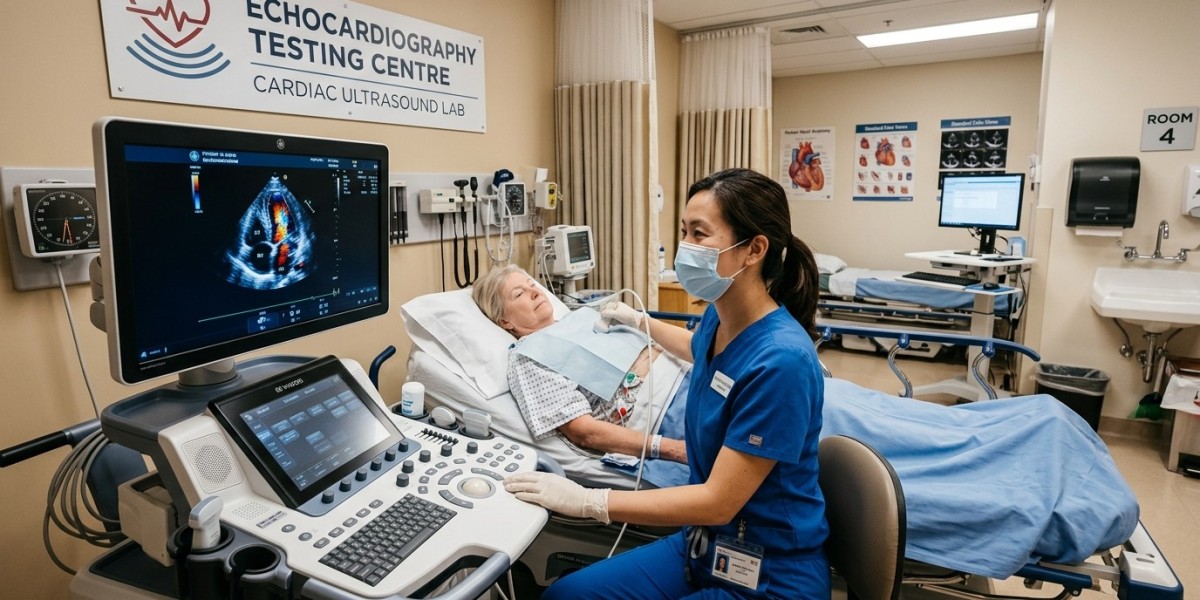
For a definitive evaluation of heart valves or fine cardiac structures, cart-based systems remain the industry standard. These machines have superior beam-forming technology and a wider range of transducers (probes) for different anatomical views. When visiting a centre, check if the equipment is a full-sized cart-based unit, which typically indicates a commitment to high-resolution diagnostic imaging over simple screening.
Machine Stability: Large cart-based units offer better image stabilization and advanced cooling systems for long scans.
Probe Variety: High-quality centres use specific probes for adult, pediatric, and transesophageal (TEE) views.
Room Ergonomics: The testing room should be dimly lit to allow the sonographer to see fine details on the monitor clearly.
Sanitization Protocols: Strict adherence to probe cleaning and disinfection is mandatory to prevent cross-contamination.
Patient Comfort: Adequate space and professional positioning help in obtaining the best acoustic "windows" for imaging.
Operational Reliability: Turnaround Times and Patient-Centricity
In the fast-paced environment of Bangalore, operational efficiency is a key component of reliability. A centre might have the best technology, but if the reports are delayed or the staff is unsupportive, the clinical value of the test diminishes. As of 2026, the average turnaround time for an echocardiography report in leading Bangalore labs is approximately 4 hours, with many offering digital delivery within minutes of the cardiologist’s sign-off.
Furthermore, look for centres that offer integrated services. A patient referred for an echocardiogram may also need a Treadmill Test (TMT) or a specialist consultation. Facilities like Ecotown Diagnostics have gained high ratings in Bangalore for providing a "one-stop" experience where diagnostics and cardiologist consultations happen under one roof. This reduces the risk of data loss between different providers and ensures that any abnormal findings are addressed immediately by a medical professional.
| Operational Marker | Standard Service | Premium Reliability |
| :--- | :--- | :--- |
| Report Turnaround | 24–48 hours | 2–4 hours (Digital) |
| Doctor Availability | Report signed remotely | On-site cardiologist supervision |
| Booking Process | Manual/Phone-based | AI-integrated app or website |
| Follow-up | Patient must take report to a doctor | Integrated post-test consultation |
| Pricing Transparency | Hidden add-ons for Doppler | All-inclusive transparent pricing |
In conclusion, evaluating echocardiography testing centres in Bangalore requires a multi-faceted approach. By prioritizing centres that utilize AI-assisted 4D technology, maintain NABL/NABH accreditation, and comply with modern data protection laws, patients can ensure they receive the most accurate assessment of their heart health. In a city where lifestyle-related cardiac risks are on the rise, investing the time to find a clinically reliable testing centre is a vital step in long-term cardiovascular wellness.