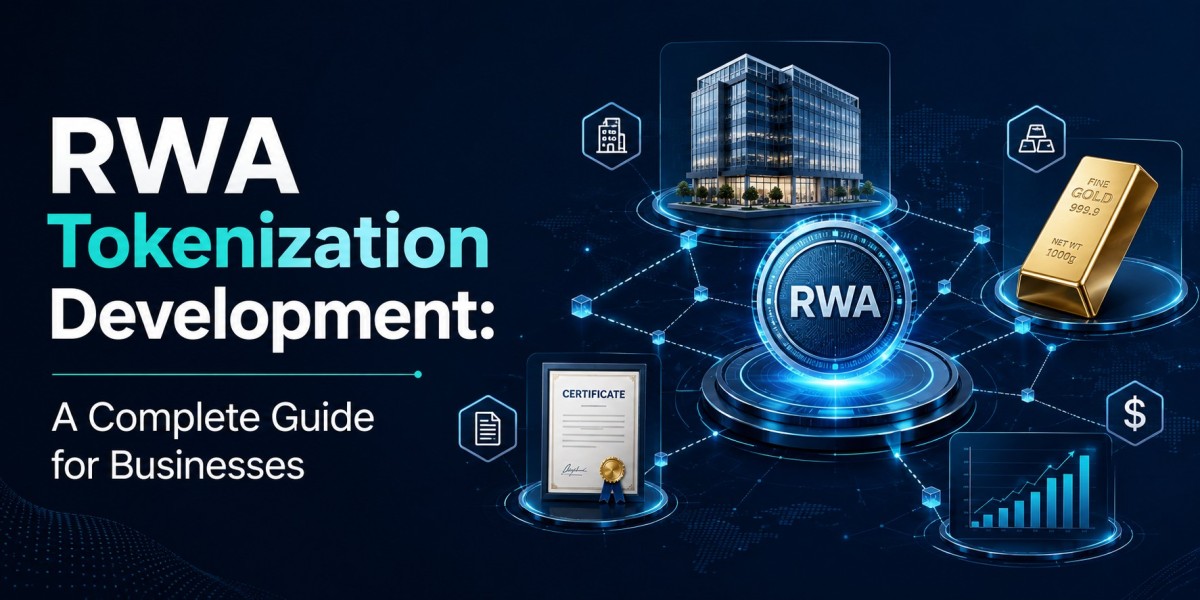

Real-world asset (RWA) tokenization is emerging as one of the most significant applications of blockchain technology for businesses and financial institutions. It enables physical and financial assets such as real estate, commodities, private credit, bonds, artwork, and other investment instruments to be represented digitally on a blockchain through tokens. By connecting traditional assets with blockchain infrastructure, businesses can explore new approaches to ownership, fundraising, settlement, liquidity, and investor access.
The concept is gaining attention because tokenization can address several limitations of conventional asset markets, including high entry barriers, lengthy settlement processes, fragmented ownership records, and restricted market access. For businesses considering blockchain adoption, RWA tokenization is therefore less about simply "putting assets on a blockchain" and more about designing a compliant digital ecosystem around ownership, transfer, governance, custody, and investor participation.
What Is RWA Tokenization?
RWA tokenization is the process of creating blockchain-based digital representations of ownership or economic rights associated with an underlying real-world asset. The underlying asset remains connected to the traditional legal and financial system, while its ownership rights, claims, or interests are represented through tokens issued on a blockchain.
For example, suppose a company owns a commercial property valued at $10 million. Instead of relying exclusively on traditional structures to divide ownership among investors, the company could establish a legally compliant tokenization structure and issue digital tokens representing defined interests in the property. Investors could potentially acquire smaller portions of the asset, subject to applicable securities, ownership, and regulatory requirements.
The token itself does not automatically make someone the legal owner of an asset. The legal relationship between the token holder and the underlying asset must be clearly established through appropriate legal agreements, corporate structures, custody arrangements, and regulatory frameworks. This connection between blockchain technology and conventional legal infrastructure is one of the most important considerations in RWA tokenization development.
Why Are Businesses Exploring RWA Tokenization?
Traditional asset markets can involve multiple intermediaries, extensive documentation, manual verification, and relatively slow settlement. RWA tokenization aims to modernize parts of this infrastructure by using blockchain networks as programmable ownership and transaction layers.
One major opportunity is fractional ownership. High-value assets such as commercial properties, luxury assets, infrastructure projects, and investment funds can be divided into smaller digital units. This can potentially lower the minimum investment threshold and create broader access to opportunities that were previously available mainly to institutional or high-net-worth investors.
Tokenization can also improve operational efficiency. Blockchain networks provide a shared ledger where transactions can be recorded transparently, while smart contracts can automate predefined activities such as token transfers, distribution calculations, eligibility checks, and certain compliance controls.
Another important advantage is the possibility of improving market liquidity. Tokenization does not automatically create liquidity, but standardized digital assets can make transfers and secondary-market infrastructure easier to develop. If an appropriate regulated marketplace exists and the relevant legal restrictions are satisfied, tokenized assets may become easier to transfer than traditionally structured ownership interests.
How Does RWA Tokenization Work?
A successful tokenization project generally requires several interconnected stages. The technical process is only one part of the development lifecycle.
1. Asset Identification and Evaluation
The first step is determining what asset will be tokenized and what economic rights will be represented. The asset could be real estate, private credit, government securities, commodities, intellectual property, or another eligible asset.
Businesses need to evaluate ownership, valuation, documentation, income generation, liquidity, risk, and transfer restrictions before designing the tokenization model.
2. Legal and Regulatory Structuring
This is arguably the most critical stage. Businesses must determine whether the token represents ownership, debt, revenue rights, fund interests, or another financial claim.
Depending on the jurisdiction and asset type, tokenized interests may fall under securities or financial-market regulations. KYC, AML, investor eligibility, disclosure, custody, taxation, and transfer restrictions may also apply.
A technically sophisticated tokenization platform can still fail commercially if the underlying legal structure is unclear. Therefore, blockchain development should work alongside qualified legal and compliance professionals.
3. Token Economics and Ownership Model
The business then determines how the asset will be represented digitally.
Important decisions include:
- Total token supply
- Token denomination
- Investor eligibility
- Ownership or economic rights
- Revenue distribution
- Transfer restrictions
- Redemption mechanisms
- Governance rights
- Fees
- Secondary-market functionality
For example, a $5 million property could theoretically be represented by 5 million tokens, with each token corresponding to a defined economic interest. The actual structure, however, must be determined by the project's legal and financial model rather than simply dividing the asset value by an arbitrary number.
4. Smart Contract Development
Smart contracts provide the programmable infrastructure behind tokenized assets. They can govern token issuance, transfers, ownership records, compliance rules, distributions, and other business logic.
Depending on the project, developers may implement features such as whitelisting, wallet verification, transfer restrictions, role-based permissions, pausing mechanisms, minting and burning controls, and automated distribution logic.
Security is particularly important because vulnerabilities in smart contracts can create financial and operational risks. Independent smart contract auditing should therefore be considered an essential part of production deployment.
5. Asset Tokenization and Issuance
After the legal, financial, and technical frameworks are established, tokens can be issued according to the project's defined structure.
At this stage, businesses also need reliable mechanisms for connecting the physical or off-chain asset with its digital representation. This may involve custodians, trustees, special-purpose vehicles, asset managers, or other regulated entities.
The goal is to ensure that the blockchain representation remains aligned with the underlying asset and the rights promised to token holders.
6. Investor Onboarding and Compliance
A tokenization platform may require investors to complete KYC and AML procedures before purchasing or transferring tokens. Depending on the asset and jurisdiction, certain investors may need to meet accreditation or eligibility requirements.
Compliance can be integrated directly into the platform so that only approved wallets can interact with restricted assets. This illustrates an important difference between conventional cryptocurrencies and regulated tokenized assets: RWA platforms often need controlled participation rather than unrestricted transfers.
Major Business Use Cases for RWA Tokenization
Real estate remains one of the most widely discussed applications because properties are valuable, relatively illiquid, and naturally divisible into ownership interests.
For example, a property investment company could create a tokenized structure that gives investors exposure to rental income generated by a portfolio of properties. Instead of purchasing an entire building, eligible investors could potentially purchase smaller interests through digital tokens.
Private credit is another significant use case. Tokenization can provide a digital representation of loans or credit instruments while supporting automated recordkeeping and settlement.
Other applications include:
Government and corporate bonds: Tokenized securities can potentially streamline issuance, settlement, and lifecycle management.
Commodities: Precious metals and other commodities can be represented through digital claims tied to assets held by custodians.
Funds: Asset managers can explore blockchain-based representations of fund interests and automate parts of subscription, transfer, and reporting processes.
Art and collectibles: High-value assets can potentially be divided into smaller economic interests, although legal ownership and custody structures must be carefully designed.
Infrastructure: Projects involving renewable energy, transportation, or other infrastructure assets may explore tokenization as a method of structuring investment participation.
Real-World Examples of RWA Tokenization
The growth of RWA tokenization is no longer purely theoretical. Several companies have developed platforms and products focused on bringing traditional financial assets onto blockchain networks.
Securitize has built infrastructure for issuing and managing tokenized securities, while Ondo Finance has focused on blockchain-based access to traditional financial products.
Centrifuge has developed infrastructure connecting real-world assets with decentralized finance. In real estate, platforms such as RealT demonstrate how blockchain can be used to represent interests in property-related investments.
These examples illustrate an important point: successful RWA projects typically combine blockchain infrastructure with asset management, legal structuring, compliance, custody, and investor services. The blockchain is an enabling layer rather than the entire business model.
Key Components of an RWA Tokenization Platform
A business-grade platform normally requires multiple technical components working together.
The tokenization engine manages asset representation, token issuance, minting, burning, and ownership records. The smart contract layer enforces predefined rules and transaction logic. A compliance layer can manage KYC, AML, investor eligibility, jurisdiction restrictions, and wallet whitelisting.
The platform may also require an investor dashboard where users can view holdings, transaction history, distributions, asset information, and compliance status. Wallet integration enables investors to manage their blockchain assets, while administrative dashboards allow operators to manage users, assets, transactions, and platform activity.
For larger projects, integrations with custodians, payment providers, valuation systems, identity providers, accounting platforms, and secondary marketplaces can become equally important.
Choosing the Right Blockchain Network
Blockchain selection should be based on the project's requirements rather than popularity alone.
Businesses should evaluate transaction costs, scalability, security, developer ecosystem, interoperability, wallet support, regulatory considerations, and institutional adoption. Public networks can provide transparency and broad infrastructure, while permissioned or specialized networks may provide greater control over participants and transactions.
Multi-chain architecture can also be considered when businesses want to reach users across different blockchain ecosystems. However, supporting multiple networks increases development, testing, security, and maintenance requirements.
The best approach is therefore to select the network that aligns with the asset, investor profile, compliance model, transaction volume, and long-term business strategy.
Challenges Businesses Need to Consider
Despite its potential, RWA tokenization is not without challenges.
Regulatory uncertainty remains one of the biggest concerns because digital tokens can have different legal classifications depending on jurisdiction and structure.
Asset verification is another challenge. Investors need confidence that the underlying asset actually exists, is properly valued, and is legally connected to the tokenized interest.
Liquidity should also be viewed realistically. Tokenizing an asset does not automatically create buyers. Secondary-market infrastructure and sufficient investor demand are necessary for meaningful liquidity.
Smart contract security is equally important. Coding mistakes, access-control vulnerabilities, oracle failures, or compromised administrative keys can expose tokenized assets to significant risks.
Finally, businesses must solve the off-chain/on-chain connection. Blockchain records can be highly transparent, but they cannot independently verify whether a physical property still exists, whether its valuation is accurate, or whether legal ownership has changed outside the blockchain.
How Businesses Can Approach RWA Tokenization Development
Businesses should begin with the asset and business objective rather than starting with blockchain technology. The first question should be: What problem will tokenization solve?
If the goal is fractional investment, the business should design an ownership structure that genuinely supports that objective. If the objective is faster settlement, the architecture should prioritize transaction efficiency and integration with financial infrastructure.
A phased approach is generally more practical. Businesses can begin with one asset class, establish the legal framework, develop the minimum viable platform, test compliance procedures, audit smart contracts, and conduct a controlled launch before expanding.
This approach reduces technical and regulatory risk while allowing the company to learn from actual investor behavior.
Future of RWA Tokenization
RWA tokenization is likely to become increasingly connected with institutional finance, fintech infrastructure, digital identity, automated compliance, and decentralized financial markets. As regulatory frameworks mature and financial institutions become more comfortable with blockchain infrastructure, tokenized assets could become an increasingly important component of digital financial infrastructure.
The long-term opportunity is not simply creating more tokens. It is building infrastructure where ownership, compliance, settlement, reporting, and asset servicing can operate more efficiently through programmable digital systems.
For businesses, this means the competitive advantage will likely come from combining strong asset fundamentals with reliable legal structures, secure technology, transparent governance, and an effective investor experience.
Conclusion
RWA tokenization development provides businesses with an opportunity to connect traditional assets with blockchain-based financial infrastructure. From fractional real estate investment and tokenized bonds to private credit and commodities, the technology can potentially improve accessibility, transparency, automation, and settlement efficiency. However, successful implementation requires far more than smart contract development. Legal structuring, regulatory compliance, asset custody, valuation, investor onboarding, security, and secondary-market strategy must all work together. Businesses exploring this opportunity can work with experienced blockchain development providers to build a secure and scalable RWA tokenization solution tailored to their asset and regulatory requirements. Blockchain App Factory also provides best RWA tokenization services, helping businesses explore token issuance, smart contract development, platform architecture, and blockchain integration for their tokenization initiatives.